The call from the arbitration office
On the morning of August 22, I got a phone call from the labor arbitration office telling me the decision was ready for pickup. I went that same afternoon.
It was drizzling outside, which somehow matched the mood. I was nervous, but I still believed the arbitration office would give a fair result.
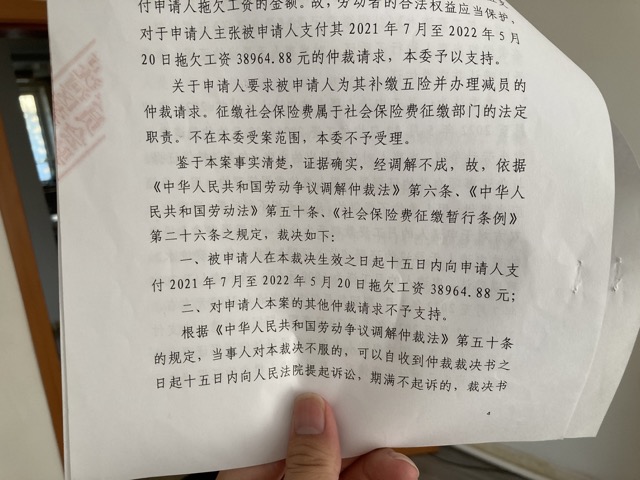
What the decision said
The ruling supported my claim for unpaid wages.
As for the unpaid social insurance contributions, the arbitration office did not accept that part of the case because it was outside the scope of labor arbitration. The decision itself was dated August 18.
More than 15 days later, still no wages
By September 7, more than 15 days had passed since I received the arbitration decision, and the company still had not paid me.
I called the boss to press for payment, but they still refused to pay. When I said I would go to court and apply for compulsory enforcement, the response was basically, "Go ahead," and then the call was hung up.
So I prepared the materials for enforcement: an application for compulsory enforcement, a copy of my ID, a copy of my bank card, and the arbitration award. That afternoon I went to the people’s court.
But because of pandemic controls, entry required a phone appointment. Without one, security would not let anyone in. I called to make an appointment and was told it could not be handled for the time being because some forms had to be filled out at the service window, and the window was not open. I was told to wait until the pandemic situation improved—basically, until the court allowed people to enter without this extra appointment barrier.
Later, people in a group chat mentioned that there was a WeChat mini-program for filing, so that night I tried submitting the case there instead. I figured it would probably need staff review.
Meanwhile, for the unpaid social insurance, I filed online complaints through several channels, including the mayor’s mailbox and the tax bureau, just to see whether any of them would produce a response.
The mini-program failed, and the social insurance issue started turning into a maze
On September 9, the result from the mini-program came back: "Review not approved, file by mail."
That left me confused again.
After searching online, I found an official mailing address and contact number for filing by post. I called, but no one answered. It was after 4 p.m., so maybe staff had already left for the day. I planned to call again the next morning to confirm whether labor arbitration enforcement applications could be mailed. If no one answered again, I would just mail it anyway.
During this stretch, another suggestion was to try 12345. I called and explained the situation. They said they would record both the unpaid social insurance and the fact that my coverage had not been formally terminated, and that someone would contact me within 10 working days.
At one point I was told to go through labor arbitration, and I had to explain that I already had: arbitration handled only the wage portion, and now I still needed to apply to the court for enforcement. The staff member asked for the company’s address. Even though they only asked for the address, I also made sure the company name was recorded. Otherwise it felt too uncertain.
September 10 to 19: mailing the court materials, then getting bounced from office to office
I eventually managed to get through to the court by phone, but no one answered there either, so I went ahead and mailed the materials.
Only afterward did I realize it was right around the Mid-Autumn Festival, so delivery to the court was delayed by the holiday. The package was finally signed for on September 13.
Then on September 15, I got a call from a pension-related staff member through the 12345 channel. I was told I needed to go to the tax bureau and ask them to urge the company to pay the overdue social insurance.
So that afternoon I went to the tax bureau.
There I was told they could not handle it, and that I should go to the agency responsible for administration and ask them to pursue the payment. They gave me the address of a medical insurance service office, so I went there next.
At the medical insurance office, I was told they did not handle it either.
Then I called the Shenyang labor security supervision complaint hotline. I was told that since 2018, their office had no longer been responsible for unpaid social insurance cases, and that I should try the tax inspection bureau.
I looked up the tax inspection bureau and went there, only to have security tell me that ordinary members of the public generally could not enter that location. It did not seem to be a public-facing office at all.
On September 16, I also left a message through the State Council client app, though I honestly did not expect much from it. On September 18, I left another message with the Shenyang Human Resources and Social Security Bureau.
On September 19, I finally found a phone number for the social insurance audit and inspection department. The person who answered said she was not familiar with the issue, took down my phone number, and said someone would call back later. She also mentioned that, during the pandemic, many staff members had been reassigned to checkpoint duty.
They did call back, but only to give me another number for the enterprise pension division. That line either did not connect, or when it did, I ended up back at the same dead end I had already hit on September 15. It was the same cycle all over again.
At that point I even left a message on the medical insurance website and quoted Article 86 of the Social Insurance Law:
第八十六条 用人单位未按时足额缴纳社会保险费的,由社会保险费征收机构责令限期缴纳或者补足,并自欠缴之日起,按日加收万分之五的滞纳金;逾期仍不缴纳的,由有关行政部门处欠缴数额一倍以上三倍以下的罚款。
The reply I got was that the tax bureau was the collecting authority.
That was when the whole thing started to feel absurd.
So I called the tax bureau again, and this time I finally found at least a narrow path forward. I dialed 12366 and followed the prompts until I got a live agent. The menu options did not seem to match the issue very well, and I eventually selected something related to small business reporting just to reach a person. That turned out to be enough.
The agent took down the company’s address and my surname. At first she suggested labor arbitration, and I had to explain again that arbitration was already finished. She then asked whether the wages awarded in arbitration had been paid. I said no. Her answer was that, in that case, they could only urge payment of the social insurance up to the month in which wages had been paid. I said that would still be something. As for whether the insurance could be formally stopped, she said she was not sure; their side could only push for payment.
September 20 to 21: the tax bureau follows up
On September 20, the tax bureau called me back and asked about the unpaid contributions. They told me to prepare a copy of the labor arbitration award—which I already had ready after being sent around so many times.
That afternoon I got another call. This time they began saying that the company had declared the insurance but had not paid, and that maybe the company really had no money. They also admitted they had not yet actually contacted the company. I asked whether the insurance had to be made up before it could be formally terminated. The answer I got was that it could be terminated. Then the person said another call was coming in, hung up, and said they would call me back later. They never did.
By then I had little confidence in what I was being told and was already thinking maybe I should just get the insurance stopped if that was even possible.
On September 21, the tax bureau called again. This time it was a man. He asked the same basic questions: how the arbitration had been decided, whether the wages had been paid, and whether the unpaid wage amount was larger than the unpaid social insurance amount. I told him the wage amount was larger.
He said their office could not do anything about wages, but they would try to coordinate the social insurance part.
September 25 to 26: the court finally accepts the enforcement case
On the evening of September 25, I submitted a clue through a wage arrears reporting mini-program. I filled in a long list of information, only to get an error at submission saying the amount format was wrong. After messing with it for quite a while, I finally realized the form would not accept decimals.
Then on the morning of September 26, around 9:30, while I was in the bathroom, I suddenly got a call from the court. They said they had received the materials I mailed for case filing and asked me to come to the court to complete some additional paperwork.
So I went that afternoon.
I filled out three forms. I do not remember all the details clearly, but one asked for my address and phone number, and another seemed to be an enforcement item list. It took only a few minutes. The process was so straightforward that it almost felt strange after all the earlier runaround. I even asked again, "So this means it’s officially accepted?" And I got a clear yes.
It was my first time going to court. I arrived too early and had to wait about half an hour before the building opened. Once it did, people scanned the required code to enter, then took the elevator upstairs, got a queue number, and waited to be called. Since I went in right when access opened, my number came up within a few minutes.
At that point the case had been accepted. The rest would depend on the legal process.
As far as procedure went, I had now done what I could on both fronts: the unpaid wages and the unpaid social insurance. All that was left was to wait.
September 27: at least some movement on the social insurance complaint
On September 27, I got a follow-up call about the tax complaint. I said that the previous tax bureau staff member had told me they would try to coordinate matters, but I had heard nothing afterward.
The caller then told me that they had already spoken with the company and that the company would handle the social insurance issue. He also said I could call him again later if anything came up—for example, if the company still did not fix it.
From what I understood, social insurance back payments could only be processed at the beginning of a month, which meant it would have to wait until the following month. But the following month was also the National Day holiday period, so I asked whether, even if everything went smoothly, it would likely only happen after the holiday. He said yes.
So I said I would call again after the holiday if the company still had not made up the payments.
September 30: one more confirmation of how the system actually works
On September 30, the wage arrears platform passed my report to labor inspection, and labor inspection then called me.
They told me that since I had already gone through arbitration, I should not be circling back to them. Once arbitration is done, the next step is the court.
That made the chain of procedures much clearer to me:
wage arrears platform / labor inspection → labor arbitration → court
The arbitration case was over, but the rights-protection process clearly was not.