A business mailbox can seem like a perfectly good way to send blog comment notifications—until its spam controls decide otherwise. In this case, Alibaba Cloud’s enterprise email had been delivering those notifications reliably, then suddenly began rejecting them as spam.
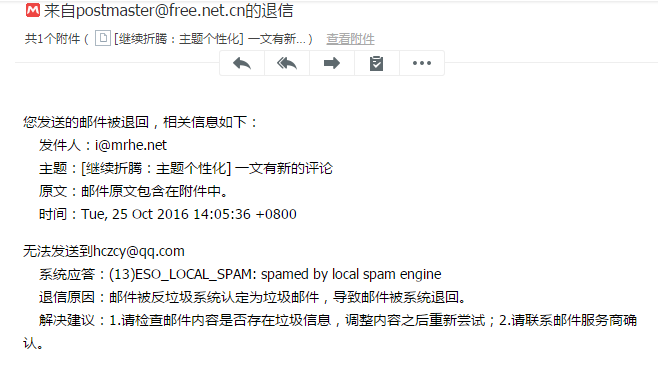
The useful question was not just how to get one blocked message through, but whether a business mailbox was the right tool for automated notifications in the first place.
What the support reply clarified
A support ticket submitted overnight received a response the next day. The engineer said the service would make adjustments for the submitted email sample to improve its chances of being sent successfully, and suggested trying again the following day.
That came with an important qualification: enterprise email was intended primarily for ordinary business correspondence. It did not support the kind of automated messages involved here, including registration verification emails, reminders, and other event-triggered notifications. Support recommended using Alibaba Cloud’s Direct Mail service for those instead.
So the problem was not simply an unreliable mailbox. The notifications belonged to a category of email for which Alibaba Cloud offered a separate sending service.
A service built for automated email
Direct Mail was described as an email delivery service for transactional messages, notifications, and bulk email. Built on Alibaba Cloud infrastructure, it offered APIs and flexible ways to connect applications, without requiring users to set up and maintain their own mail server.
The service description also highlighted its sending speed, stability, and delivery rate, citing two years of use during the Double 11 shopping event as evidence of its ability to handle demanding workloads. Those were the provider’s stated strengths, rather than results from an independent delivery test.
The accompanying material also discussed an SMS platform supporting China’s three major mobile operators. It mentioned dedicated messaging channels, custom SMS templates, self-service integration through an open API, and infrastructure designed for high-volume, concurrent traffic. Those SMS features were separate from the email delivery capability needed for blog comments.
For a small blog, the most immediately useful detail was the free sending allowance: each Alibaba Cloud primary account was offered 200 emails per day. At that level, a modest stream of comment notifications could fit comfortably within the daily quota. This was the allowance described at the time of the setup, not a guarantee that the same terms would remain unchanged.
Following the service’s setup instructions was enough to get the configuration completed quickly. There was also a small DNS discovery along the way: third-level domain names could be configured too. A useful extra bit of knowledge from what had started as a frustrating delivery problem.