People often search for things like “default walkie-talkie frequency,” “16-channel frequency chart,” “UV radio frequencies,” or “public channel list,” as if handheld radios came with some universal set of channels that everyone can use out of the box.
In mainland China, that is usually not how it works.
For most walkie-talkies on the market, there is no general-purpose default frequency table that applies across brands and models. And a lot of the confusion starts with one mistaken assumption: if a radio has channels, then those channels must already correspond to some standard set of frequencies that anyone can legally use. In reality, legality, licensing, approval type, and intended use all matter.
Why this question is so common
This is one of those topics that feels obvious to radio hobbyists or communications technicians, but is not obvious at all to ordinary users. If you are not already familiar with radio regulation, it is perfectly reasonable to assume that a walkie-talkie works like any other consumer device: buy it, switch it on, talk.
That assumption breaks down quickly.
A search log for these questions usually falls into several broad groups:
- people asking for a “default” frequency, channel, or band
- people asking for a frequency/channel reference chart
- people asking about a specific use case, place, or brand
- people searching a single frequency and trying to figure out what it is
- people searching for foreign standards such as PMR446 or UHF CB
To answer those properly, you first have to understand one thing: most radios are not simply free to use however you like.
There is no universal default frequency
If someone asks, “What frequency should I set my walkie-talkie to?”, the honest answer is often: that depends on what kind of radio it is, what it was approved for, what you are using it for, and whether you hold the required authorization.
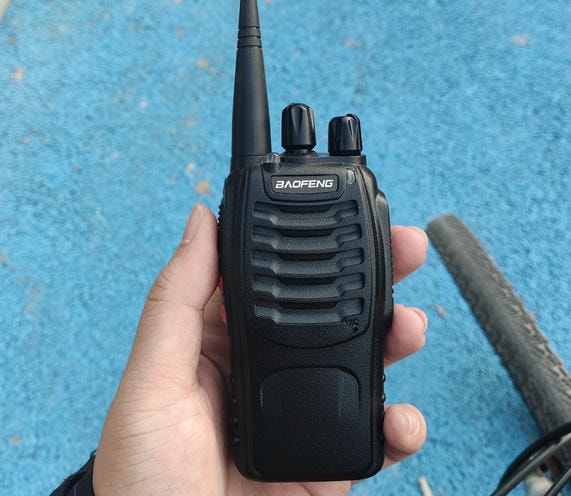
In China, using radio equipment generally involves licensing unless the device belongs to a specific exempt category. A “public walkie-talkie” is a technical and regulatory term, not a casual label for any handheld radio sold online. Many radios marketed to ordinary buyers are not public walkie-talkies in the legal sense.
Depending on the device category, the answer changes:
- Public walkie-talkies or new common-use digital radios under the national standard use predefined channels. In those cases, the channels are fixed by regulation.
- For example, public walkie-talkie channel 9 is 409.850 MHz.
- A common-use radio channel 36 is 406.650 MHz, or 406.428125 MHz in the 240-channel mode.
- Licensed commercial radios must use the exact frequencies stated on the station license. If the license says 415.8625 MHz, then that is what you use.
- Many cheap radios sold online or offline are a different story entirely. A large number of them are effectively overspec or misused devices: approved under amateur-radio handheld categories, but then sold into hotels, construction sites, restaurants, KTV venues, security work, and similar business settings where they do not actually belong.
Why so many radios on the market are misleading
Radio equipment in China is supposed to carry an approval identifier, the CMIIT ID, just like other wireless devices. But a long-running market problem has developed around analog walkie-talkies.
At the end of 2009, the Ministry of Industry and Information Technology issued a notice commonly known as the 2009 No. 666 document, which stated in Section 6 that model approval for analog walkie-talkies in the relevant band would stop from January 1, 2011, and existing approvals would no longer be renewed after expiry.
The intent was straightforward: phase out analog equipment and promote digital radios to save spectrum resources.
What happened in practice was different. Digital sets cost more; analog sets are cheaper. So manufacturers looked for ways to keep selling low-cost analog radios. One approval type that remained relatively easy to obtain was “FM handheld station (amateur service),” often marked with a frequency range such as 430–440 MHz.
That approval category ended up being used by a huge range of radios, including:
- simple knob-only 16-channel handhelds
- screen-equipped handhelds such as the UV-5R and UV-K5/K6
- some Xiaomi radios
- various mobile radios
The problem is twofold:
- many of these radios can actually be tuned beyond their nominal approved range, so they are effectively overspec devices;
- users are often unaware of the regulatory background, so these radios get used casually in bands where they should not be used.
That leads to interference with amateur radio users and even with the primary services assigned in parts of that spectrum, including aeronautical radionavigation/radiolocation.
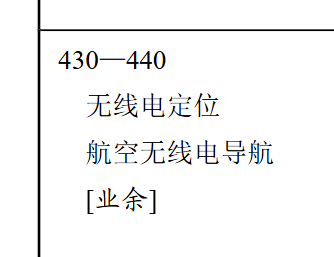
And this is where another misunderstanding appears: amateur radio does not mean “free for anyone to use.” It still requires an amateur radio operator certificate and station licensing.
If your use case is road trips, off-roading, hiking, or similar personal activities, then getting licensed and using amateur equipment can make sense. But if your use case is commercial—construction, hotels, restaurants, security, entertainment venues—then using those amateur-approved radios in that role is not appropriate, and licensing does not automatically make that business use compliant.
If you already own one of these radios
There is no perfect answer, but there is a pragmatic one that tends to reduce harm.
One workable approach is to ask the dealer to program the radios onto the 20 public walkie-talkie channels in the 409.750–409.9875 MHz range. If the radio only supports 16 channels, then only the first 16 can be written.
Strictly speaking, this is still not the cleanest regulatory solution. But compared with interfering with other radio services, it is far less harmful.
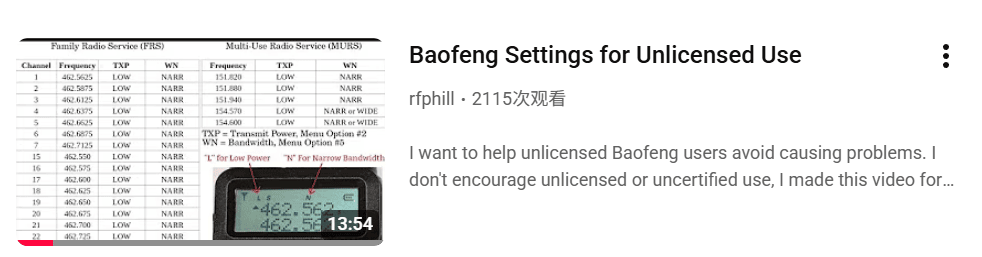
This kind of “damage reduction” is not unique. Similar behavior appears worldwide. Software like CHIRP includes license-free channel presets for some countries and regions, intended to be written into ordinary radios. And there are plenty of tutorials showing how to tune general-purpose handhelds to U.S. FRS or GMRS channels, even though U.S. rules also require approved equipment under FCC Part 95. The reasoning is familiar: people will do it anyway, so better to steer them away from causing worse interference.
“Public frequency,” “civilian frequency,” and “emergency frequency” are not real answers
These phrases sound useful, but in China they are either imprecise or simply not established technical categories.
“Public frequency” / “civilian radio frequency”
If someone means the narrow, formal category of public walkie-talkie frequencies, then yes: that refers to 409.750 MHz to 409.9875 MHz.
But many online ads and reposted charts claim that 400–470 MHz is some kind of “civilian” range. That is wrong. It is far too broad and contains many different services. For example:
- 406–406.1 MHz is used for global distress beacons
- 450–470 MHz is currently used by China Railway
“Civilian” never means “use it freely.”
If what you actually want is a maritime public calling frequency, then the key example is marine channel 16 at 156.8 MHz.
“Emergency frequency”
There is no general walkie-talkie emergency frequency in the way many people imagine.
This question often comes from hikers, off-road drivers, or people planning remote travel who hope there is some shared emergency channel in the wilderness. Unfortunately, there really is no such universal radio solution. In genuinely remote areas, a satellite phone is a much better safety tool.
“Amateur radio frequency”
That phrase is also too vague to answer cleanly.
Amateur radio allocations span many bands from longwave to microwave. If you are a beginner with a newly bought handheld and you simply want to listen to local amateur activity, the practical route is to ask local operators or look up nearby repeater information for your area, then monitor those frequencies.
Why a “16-channel frequency chart” usually doesn’t exist
A very common assumption is that if a radio has 16 channels, then channel 1, channel 2, channel 3, and so on must correspond to a known national standard.
For ordinary Chinese-market 16-channel handhelds, that is usually false.
Outside of formal standards such as the 409 MHz public channels or the 406 MHz common-use channels, the mapping between channel numbers and frequencies is whatever the dealer or seller programmed into the radio. So one radio’s channel 1 may be completely different from another radio’s channel 1.
That is why two 16-channel radios may fail to talk to each other even when both are set to “channel 1.”
The most reliable way to find the actual frequencies is to read the radio with a programming cable. A frequency counter can help with transmit frequency, but it will not tell you the receive configuration.
The actual 409 MHz public walkie-talkie channel table
<table> <thead> <tr> <th>Channel</th> <th>Frequency</th> <th>Channel</th> <th>Frequency</th> </tr> </thead> <tbody> <tr> <td>1</td> <td>409.7500</td> <td>11</td> <td>409.8750</td> </tr> <tr> <td>2</td> <td>409.7625</td> <td>12</td> <td>409.8875</td> </tr> <tr> <td>3</td> <td>409.7750</td> <td>13</td> <td>409.9000</td> </tr> <tr> <td>4</td> <td>409.7875</td> <td>14</td> <td>409.9125</td> </tr> <tr> <td>5</td> <td>409.8000</td> <td>15</td> <td>409.9250</td> </tr> <tr> <td>6</td> <td>409.8125</td> <td>16</td> <td>409.9375</td> </tr> <tr> <td>7</td> <td>409.8250</td> <td>17</td> <td>409.9500</td> </tr> <tr> <td>8</td> <td>409.8375</td> <td>18</td> <td>409.9625</td> </tr> <tr> <td>9</td> <td>409.8500</td> <td>19</td> <td>409.9750</td> </tr> <tr> <td>10</td> <td>409.8625</td> <td>20</td> <td>409.9875</td> </tr> </tbody> </table>A few common scenario-specific questions
Hainan’s “419” channels
In Hainan, users can additionally use 20 channels for digital radios, which makes local operation more convenient.
In simple terms, these correspond to the 20 public channels above, each shifted upward by 10 MHz. The formal table can be checked through the provincial MIIT-related channels.
Xiaomi / BeeBest default channels
Some Xiaomi handhelds ship with default channels in the amateur band, while also being marketed in ways that suggest commercial usability, with only small-print reminders that amateur licensing is required.
That creates a predictable mess: users buy them casually, cause interference, and may even face confiscation or penalties for unlawful use.
The default 20 “long-distance” channels are essentially frequencies in the 70 cm amateur band, running from 430 to 439 MHz, with the decimal endings .1375 and .4375:
- 430.1375
- 430.4375
- 431.1375
- ...
- 439.4375
If someone likes the Xiaomi ecosystem and wants something more compliant, the public-network models are one option, and the newer digital walkie-talkie is basically a common-use radio under the newer national standard, though ecosystem lock-in is something to keep in mind.
Yangtze, marine, and vessel-related frequencies
If you want marine VHF frequencies used on ships, the important calling/distress frequency is still channel 16, 156.8 MHz.
If you mean fishing-vessel FM radio telephone sets, their 480 channels cover 27.5 MHz to 39.5 MHz, and the governing document can be found through the Ministry of Agriculture and Rural Affairs.
If you mean Changjiang Voice, the Yangtze River water traffic safety broadcast station, its frequency is 160.650 MHz and it can be received in areas along the river.
“Public 460,” “460 MHz,” or “462–467 MHz”
As a domestic walkie-talkie standard in China, this does not exist.
Some online “public frequency tables” incorrectly place 462 MHz next to the Chinese 409 MHz public channels. Those 462–467 MHz frequencies are actually U.S. FRS/GMRS channels—essentially the American counterpart to license-free personal radios.
Since spectrum allocations differ from country to country, using 462 MHz walkie-talkies in China is not legal. By the same logic, Chinese 409 MHz public sets are unlikely to be legal in many other places.
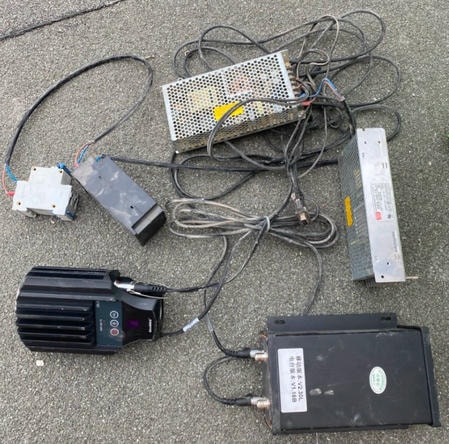
If you recently noticed news involving an illegal 460 MHz transmitter, that was likely unrelated to ordinary walkie-talkie use. One reported case appears to have involved a privately set up RTK base station used to provide higher-precision positioning for a driving school training ground.
“What’s the police channel?” / “350 channel”
There is a reason people still ask this: the 350 MHz band used to be associated with police communications.
But that no longer helps much. Police systems are now almost entirely digital, and usually encrypted as well. Even if you receive a signal, an ordinary person is not going to decode it.
Manufacturers still like to advertise 350 MHz receive coverage because it sounds exciting to inexperienced buyers. Years ago, when some police traffic was still analog, you really could tune in with suitable equipment. Then digital systems arrived—first with standards like TETRA, and later domestic systems such as PDT.
Even in places where legacy analog systems may still survive for special reasons, they are often trunked systems with changing frequencies, so an ordinary handheld cannot follow them. In practical terms, that era is over.
What do “U band” and “V band” mean?
These terms are very broad and are often used loosely.
If someone means the bands commonly supported by consumer handheld radios, then:
- U band usually means 400–470 MHz
- V band usually means 136–174 MHz
But a radio being able to tune those ranges does not mean you are free to transmit there.
If someone means the amateur bands by those nicknames, then in ordinary usage:
- U refers to 430–440 MHz
- V refers to 144–148 MHz
Using those amateur allocations requires an amateur operator certificate and station license.
What some specific frequencies actually are
A lot of searches are just raw frequencies. People see a number on a radio, in an app, on a product page, or in a video, and want to know what it means.
162.5 MHz
In China, this is one of the same-frequency simplex channels for dedicated professional radios, which means legal use requires payment of frequency occupation fees and a radio station license.
But if you saw 162.5 MHz on an export radio or imported receiver labeled WX or NOAA, that is because it is one of the U.S. NOAA weather radio channels. In the United States and Canada, those channels carry weather reports and alerts. Outside those countries, including in China, they are effectively useless because there is no local transmitting network for that service.
China once had weather broadcasting of its own, but that was different in frequency and has already been discontinued.
“200 MHz walkie-talkie”
Some newer radios support a 200 MHz range, typically either 200–250 MHz or 240–260 MHz. In China, those are not ordinary walkie-talkie bands.
The 230 MHz area is used for data radio by the power sector. The handhelds you can buy that cover 200 MHz are often intended for export:
- the lower range may target countries using the 1.25 m amateur band (220–225 MHz)
- the higher range may target Southeast Asian markets; for example, Thailand has public channels around 245–247 MHz
There is also an older gray-market angle: if you see mysterious 200 MHz radios sold second-hand with earpieces, they may well be former exam-cheating radios, once used to transmit answers from outside a test site to candidates inside. That trick is much easier to catch today thanks to better monitoring equipment.
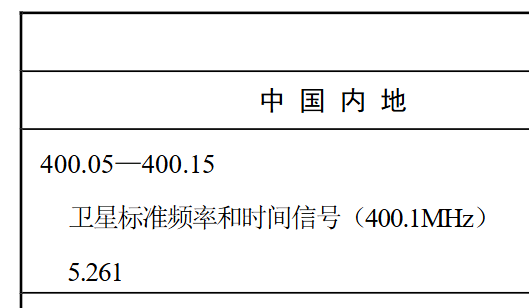
400.125 MHz
This is a factory default frequency on some display-equipped radios.
Unfortunately, that does not make it a valid ordinary walkie-talkie frequency in China. The radio can tune there, but that does not mean you are allowed to use it there.
463.4125 MHz
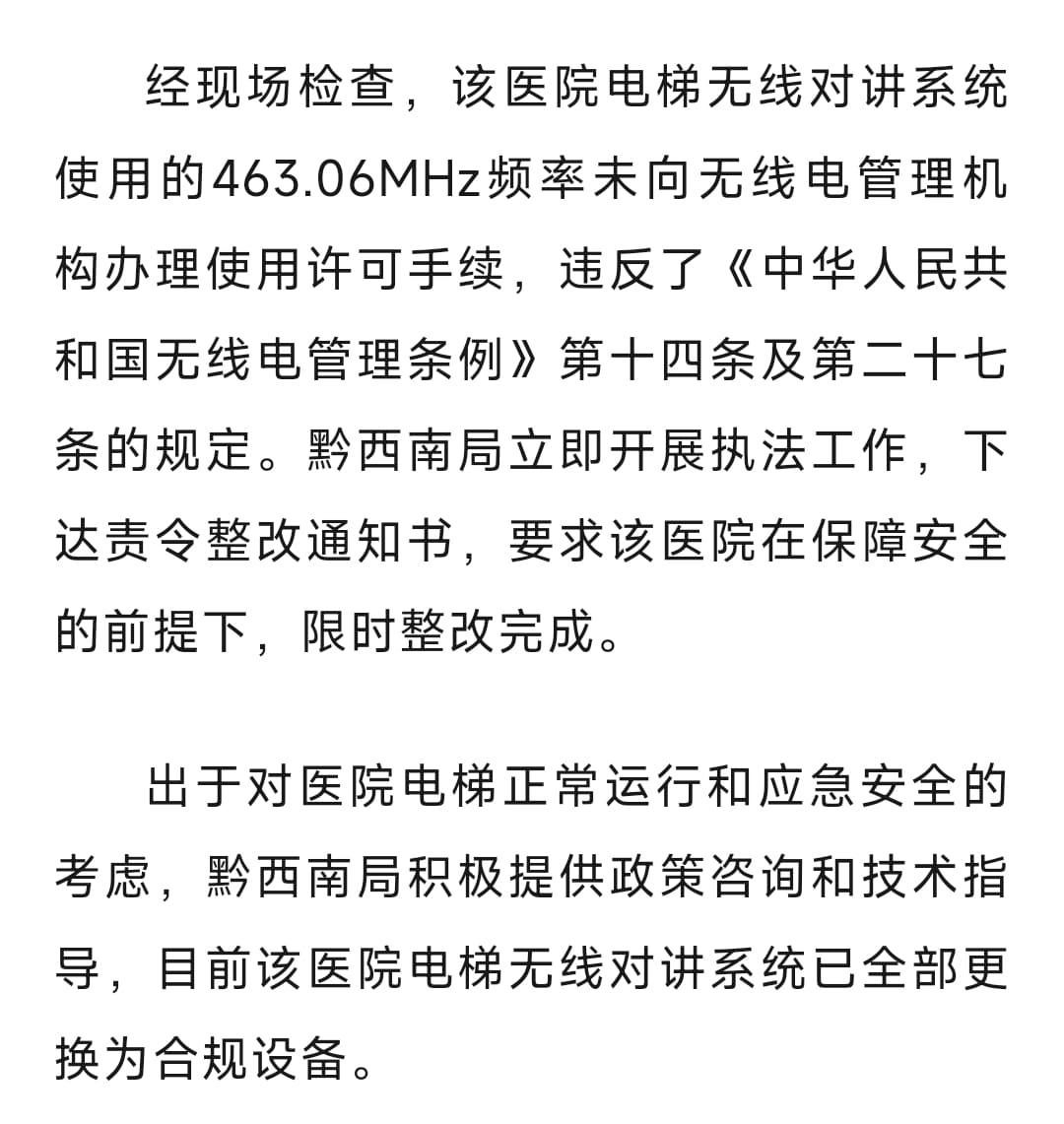
As noted earlier, 450–470 MHz is currently used by China Railway, so normal professional walkie-talkie use there is not allowed.
When odd-looking frequencies such as 463.4125 MHz appear, they often come from one of two sources:
- an overspec no-screen handheld that a seller programmed with that frequency
- certain elevator five-party intercom systems that illegally use it
That second category is surprisingly common. Some wireless elevator intercoms use 463 MHz; others use 409 MHz, including examples that collide directly with actual public walkie-talkie channels such as 409.850 MHz.
One plausible explanation is that manufacturers saw public-radio channel lists—sometimes even incorrect ones that mixed in U.S. FRS channels—and then simply shifted upward a bit. For example, if someone looked at 462.725 MHz, the last U.S. FRS channel, and casually “moved up” into the next MHz, they would land near 463 MHz.
422.425 MHz
In China, this is again one of the same-frequency simplex channels for dedicated professional radios, requiring licensing and fees.
But if you saw a Japanese handheld covering 422.425 MHz on a resale platform, that likely relates to Japan’s specified low-power radios, a special category somewhat comparable to one form of public personal radio there.
Their output is tiny—about 10 mW—and they operate in parts of the 421/422/440 MHz ranges, with repeaters allowed. Typical range is only tens to hundreds of meters, though enthusiasts have occasionally pushed them to kilometer-scale or even longer contacts under exceptional conditions.
430–440 MHz, “430 civilian band,” 144–148 MHz
These are not public-use bands. They are amateur radio allocations.
That means no matter how often a seller labels them “civilian,” using them legally still requires an amateur operator certificate and station license.
A major real-world problem is that many unlicensed users, especially commercial vehicle users, occupy these frequencies casually and even spill into the amateur satellite segment at 435–438 MHz. Searches for frequencies like 437.750 MHz reflect exactly that kind of overlap.
The reasons are shared across the whole chain: sellers program frequencies carelessly, users do not verify them, regulators have not always done enough public education, and legal alternatives are not always easy for casual buyers to understand or obtain.
If you already own this kind of radio and cannot replace it immediately with a compliant model, reprogramming it onto the public 409 MHz channels is at least a more defensible temporary compromise than leaving it in amateur allocations.
433 MHz
This is also in the amateur radio area in China. It is not used as a general ISM band in the domestic Chinese sense.
If you see a remote control using 433 MHz, that does not mean the whole band is a free-for-all. Rather, low-power national rules carve out limited use there for certain remote-control functions. That does not automatically legalize things like general data radios or FPV systems on 433 MHz.
151.820 MHz
This frequency is also one of the dedicated professional simplex frequencies in China and therefore requires a station license and associated spectrum authorization.
A frequent scam or misunderstanding involves so-called “license-free VHF channels” such as:
- 151.820
- 151.880
- 151.940
- 154.570
- 154.600
These are actually U.S. MURS frequencies, with a 2 W limit, and they are license-free only in the United States. That rule does not carry over to other countries, including China.
Foreign standards are foreign standards
Searches often include overseas radio systems. Those standards may be perfectly legitimate in their own countries, but they are not legal walkie-talkie standards for use in China.
Australia’s UHF CB
This is Australia’s UHF CB service, essentially its own public personal radio system:
- 476–477 MHz
- 5 W
- 80 channels
It is popular in rural areas where distances are long and phone coverage is limited.
PMR446
This is the European license-free standard:
- 446 MHz
- 16 channels
- 0.5 W
In China, that spectrum is assigned to aeronautical radionavigation/radiolocation, not to personal walkie-talkie use.
CB radio
This usually refers to the U.S. Citizens Band service. In China, legal use is generally associated only with Hong Kong, while the status in Taiwan is another question.
Typical CB characteristics are:
- around 27 MHz
- 40 channels
- 4 W AM or 12 W SSB
Because it developed early in the United States, CB also built a strong culture around slang, operating habits, and media representation. It is still used today, especially by truck drivers.
The practical takeaway
If you are looking for a single chart of “ordinary walkie-talkie frequencies” in China, you are usually looking for something that does not exist.
What exists instead is a patchwork of:
- regulated public channels
- common-use digital channels under specific standards
- licensed commercial assignments
- amateur bands that require qualification
- foreign standards that do not apply domestically
- and a large gray market of radios sold with misleading defaults
So before asking “What is the default frequency?”, the better questions are:
- What category is my radio actually approved for?
- What is my intended use: hobby, travel, business, marine, or something else?
- Do I need a license?
- Are the channels in my radio dealer-programmed rather than standardized?
Very often, that is the difference between a harmless setup and an illegal one.