Among Xu Zhimo’s many famous lines, a few from his letter to Liang Qichao are especially revealing:
I dared to brave the world’s condemnation and fight with all my strength not merely to escape grievous suffering, but to settle my conscience, to establish my character, and to save my soul.
Who does not prefer ordinary virtue? Who does not cling to what is ready at hand? Who does not fear danger and hardship? And yet there are still those who break out and force a way through—how could it be otherwise, unless they had no other choice?
I will seek, in the vast sea of humanity, the one and only companion of my soul. If I find her, I am fortunate; if I do not, then that is my fate. That is all.
Alas, my teacher! I have once gathered the very essence of my soul into a luminous pearl of ideal, steeped it in the hot blood of my heart, and let it shine upon the deepest chambers of my spirit. But the vulgar resent it and envy it; they would numb the soul, shatter ideals, extinguish hope, and defile purity. That I did not sink into corruption, cowardice, and baseness was itself nearly a miracle.
These lines do more than defend a personal decision. They expose two central aspects of Xu Zhimo’s character: his near-absolute commitment to ideal love, and his enduring reverence for Liang Qichao even when the two stood sharply opposed.
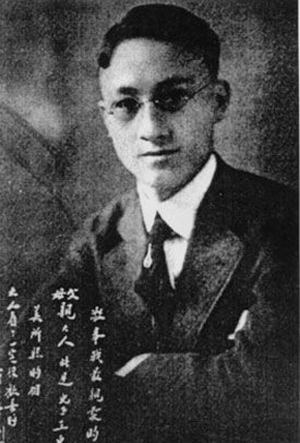
In March 1922, while in Britain, Xu Zhimo divorced his first wife, Zhang Youyi. One reason was that theirs had been an arranged marriage without love. Another was that he had fallen for Lin Huiyin, who was also studying in Britain at the time and was widely admired for both her talent and intellect.
Friends and family tried hard to dissuade him, and Liang Qichao was no exception. In his letter to Xu, Liang argued first that one must never exchange another person’s suffering for one’s own happiness. He also warned that although modern youth loved to speak of the sanctity of romantic love, such things were matters of chance, not objects to be pursued at will. He further reminded Xu that there is no perfect universe.
Liang’s objections were not simply abstract moralizing. In the social climate of the early twentieth century, divorce without love was commonly regarded as a deeply unethical act, scarcely different from casting off a wife for no just cause. He likely feared not only for the pain such a decision would inflict, but also for the damage it could do to his student’s reputation and future.
Yet after Xu returned from Cambridge, he discovered that Lin Huiyin was already engaged to Liang Qichao’s son, Liang Sicheng. At the same time, his own family opposed his divorce from Zhang Youyi. It was under these pressures that he wrote the letter now remembered as To Liang Qichao.
By 1924, Xu met Lu Xiaoman, another brilliant and celebrated woman of her generation. The two fell in love quickly. But Lu was already married, and her husband, Wang Geng, was both Liang Qichao’s student and Xu Zhimo’s friend. From Liang’s perspective, this only made the matter worse. A traditional moral code still carried force: one did not trespass upon a friend’s marriage.
Eventually, after Lu Xiaoman’s relationship with Xu had become firm, she divorced Wang Geng. On October 3, 1926, Xu Zhimo and Lu Xiaoman held their wedding in Beihai Park in Beijing. Liang Qichao attended as witness, though he would leave behind a notorious wedding address in which he bitterly denounced the couple’s attitude toward marriage.
The insistence on an ideal love
The most striking line in Xu’s letter is also the most quoted: he would search through the vast crowd of humanity for the “one and only companion of my soul.” What he sought was not beauty, not wealth, not convenience, but a spiritual counterpart. To many readers, this sounds noble; to others, unreal. Some have seen in it the impractical idealism of a poet, the pursuit of a form of love too absolute to exist in ordinary life.
That idealism becomes clearer when one considers his divorce from Zhang Youyi.
Zhang was by no means an unworthy or incapable wife, nor was she someone easily dismissed as a relic of an arranged marriage. She was attractive, talented, and a woman with political views of her own. She was four years younger than Xu. Her grandfather had served as a county magistrate in the Qing dynasty, and her father, Zhang Runzhi, was a wealthy man in Baoshan, Shanghai. She married Xu at fifteen and divorced him at twenty-two. At the time of the divorce, she already had a four-year-old son and was pregnant with another child.
When Xu raised the matter of divorce, Zhang agreed decisively. Their separation became one of the earliest celebrated examples in China of a civil divorce carried out under modern law.
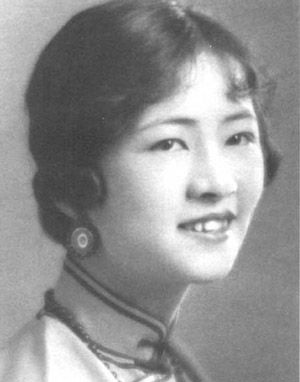
This is one major reason Xu Zhimo’s views on love have long drawn criticism. Zhang Youyi’s abilities and dignity, together with the fact that she was leaving the marriage with two children, made it easy for many people to condemn Xu on both emotional and moral grounds. From that condemnation came broader doubts about his entire philosophy of love.
Yet Xu’s own words are more severe and more demanding than they are often made to seem. “If I find her, I am fortunate; if I do not, then that is my fate.” His position was not that one should drift from one romance to another in search of poetic excitement. It was that if true love could not be found, then one should accept that fact rather than settle casually for an imperfect substitute.
This is why changing his phrase into “if I lose her, that is my fate” distorts his meaning. To lose something presumes that one first possessed it. That version turns Xu into a romantic adventurer, someone treating love as an experiment. But his original statement means something harsher: better no love at all than a love that falls short of the soul’s absolute demand.
Whether one admires or rejects that standard, it was clearly the principle by which he wished to live.
A disciple who never ceased to honor his teacher
The letter also reveals another side of Xu Zhimo: the seriousness of his respect for Liang Qichao.
Liang had sternly condemned Xu’s divorce. Later, Xu’s beloved Lin Huiyin became engaged to Liang’s own son. Xu ended that relationship decisively, and there is no sign that he allowed bitterness toward his teacher to grow from it. In the letter, his tone is earnest and unwavering. He defends his own view of love, but does so while maintaining full respect for Liang and hoping to be understood.
That same combination of firmness and deference appeared again at his wedding to Lu Xiaoman. Xu had invited Liang Qichao to serve as witness, but Liang used the occasion to publicly scold the couple, accusing them of treating marriage without proper seriousness. The guests found it difficult to bear. Xu, however, did not answer with resentment. Embarrassed and ashamed, he stepped forward, apologized to his teacher, and tremblingly pleaded: “Please, teacher, do not go on. Spare your disciple a little face.”
What is even more telling is that Xu never came to hate Liang for this humiliation.
On January 19, 1929, Liang Qichao died at Peking Union Medical College Hospital. Xu Zhimo, then in Shanghai, was devastated by the news and traveled to Beijing to take part in the memorial observances. Afterwards, he devoted great effort to publishing Liang’s posthumous manuscripts and promoting his scholarship and character. That was not a gesture of obligation. It came from genuine sincerity.
Xu Zhimo’s ideas about love will likely remain controversial. Many will continue to question the cost of his idealism, especially in light of those hurt by his choices. But his loyalty to Liang Qichao, his capacity to disagree without discarding reverence, and his faithfulness to the bond between teacher and student are much harder to dispute.