As someone once put it, custom built-ins are full of pitfalls, and every one of them is different. That turned out to be painfully accurate.
We managed to hit several of those traps ourselves, so here’s the honest version of what happened.
The materials weren’t what we ordered
For our whole-home cabinetry, we went with a local factory that handled both design and production in-house. They offered branded boards, including options like Luli and Moganshan. After looking at their showroom and feeling the price was reasonable, we paid the deposit pretty quickly and chose Moganshan eco board.
The agreement was delivery and installation within 35 days. In reality, it took about 10 extra days, and I honestly suspect it would have taken even longer if I hadn’t kept chasing them.
When the cabinets finally arrived, I even took a day off on Friday to supervise the installation and avoid the weekend rush. That was when I noticed, during installation, that the material delivered was plywood rather than the eco board we had ordered.
On the surface I stayed calm. Internally, I was furious.
I immediately called the designer we had been dealing with. Their first response was that they needed to check with the factory. Later they came back with an explanation: the worker had supposedly cut the wrong boards because a batch had arrived at the same time with the same finish but different core materials.
That explanation didn’t sit right with me at all. If that was true, then what exactly were the workers given? Just the dimensions and not the board specifications? Or were they somehow cutting panels without proper production documents? I made it clear that I wasn’t paying the remaining 1,000 yuan balance until they figured out how they intended to handle it.
That day, August 9, I still stayed there and watched the installers finish the job, except for the shoe cabinet’s tilt-out section, which was missing parts. To be fair, if you ignore the issue of the wrong board material, the final look was actually quite close to what Liuliu and I wanted. That made it even more frustrating. Visually it worked, but knowing it wasn’t what we had ordered made the whole thing deeply irritating.
A couple of days later, on August 11, while I was waiting at a 4S dealership during car maintenance, I kept thinking about their explanation and started noticing inconsistencies in it. In theory, the chance of them simply cutting the wrong material should have been very low—unless the person doing it had completely stopped caring.
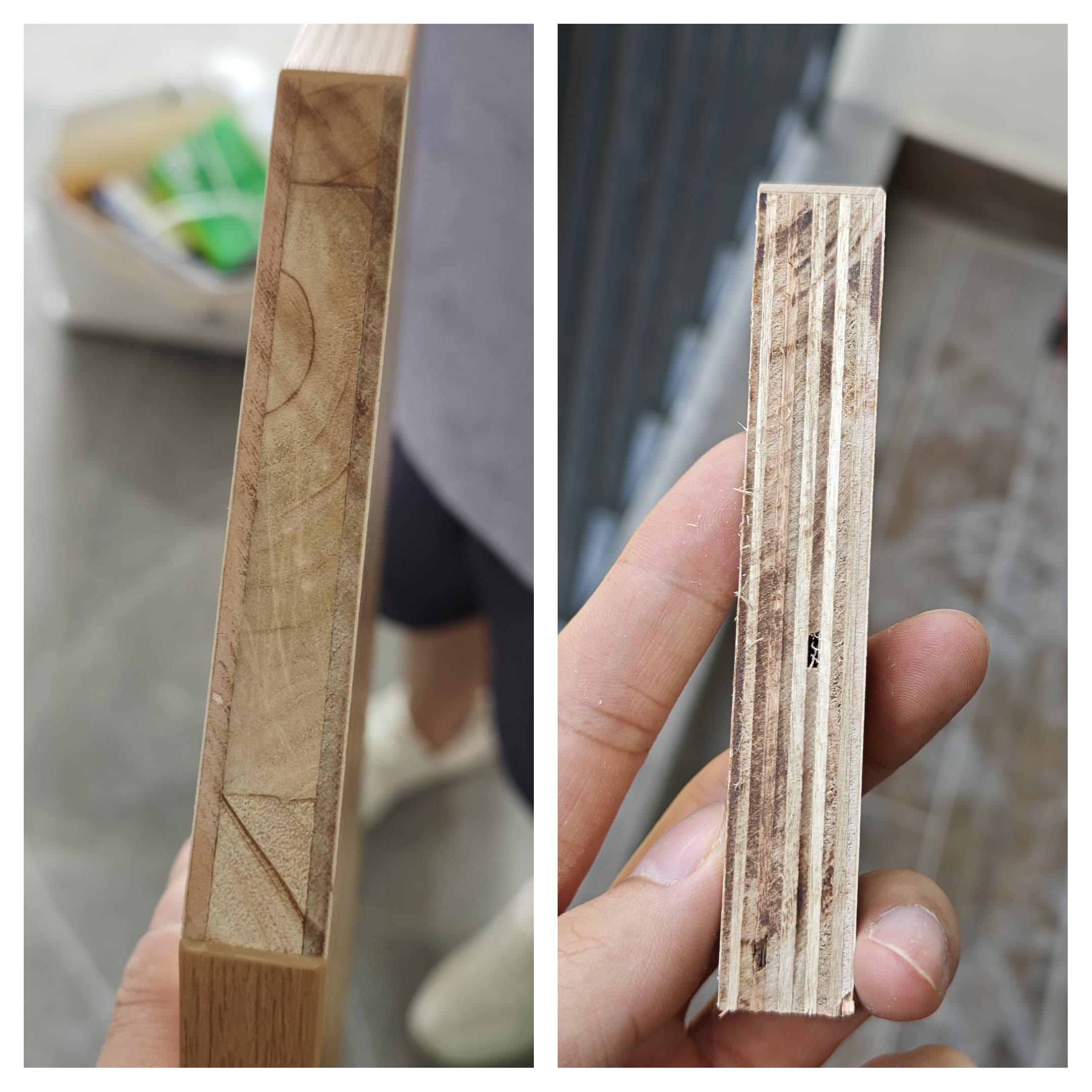
So I sent several pointed messages in the one-on-one service group they had created for us. They didn’t reply for half an hour, then said they would contact me again. When the next call came, they offered to settle the order at half price. In the end, they would refund us more than 3,000 yuan and also include one formaldehyde-removal service.
That was honestly more than we expected. After a quick discussion with Liuliu, we agreed to accept the offer.
At that point, neither side really had the energy for a full redo. They might not have been willing to remake everything, and even if they were, the time cost for us would have been too high. So this ended up being the most practical compromise.
That said, I still believe this probably wasn’t an innocent mistake. If they really had eco board and plywood with the exact same finish arriving in the same batch, that means someone else must have ordered that same finish with a different substrate. If mine got mixed up, what happened to theirs?
The tilt-out shoe cabinet turned into a disaster
Calling it a tilt-out cabinet feels too generous. It was more like a full-on wipeout.
So here’s the blunt conclusion first: do not install a tilt-out cabinet behind an inward-opening door. If it flips open by itself while nobody is home, your choices are terrible: dismantle the cabinet, remove the door, or climb in through the balcony.
We originally decided on a tilt-out design after seeing one in a model home. The cabinet depth was limited, and on paper, this seemed like the best way to maximize the space.
The theory was fine. The actual execution was the problem.
First, the hardware provided by the factory was flimsy. It was made from thin stamped sheet metal, felt soft in the hand, and had no reassuring weight to it. Second, the installers clearly misjudged the center of gravity. After installation, the cabinet wouldn’t stay closed and would automatically tip open. No amount of adjustment fixed it.
The most absurd part was that some holes had been drilled too large, and they tried filling them with glass glue as if that would somehow pass.
This cabinet had already been delayed by two weeks before they even came to install it, so I was already annoyed. Then it turned out like this, and I went back to arguing with the designer again. My idea was to abandon the tilt-out setup and switch to regular hinged doors, then add two adjustable shelves inside so the shoes could be stacked.
But when the discussion got to cost, they said that because we were changing the plan, they couldn’t give us the 50% settlement anymore. It would only be 20% off, and on top of that we’d have to wait for a combined order with no clear timeline.
That was the point where my patience was gone. My view was simple: if they installed it this badly, I was already being generous by not demanding the fix for free.
They still said they could try to correct it, but by then I had no confidence left in them.
After talking it through several times with Liuliu, we gave up on changing it to hinged doors. Instead, we bought solid wood shelves ourselves and added a curtain in front as a cover. It solved the problem, stayed practical, and actually made daily use easier since you can just pull the curtain aside to grab shoes. The curtain also lets you choose a pattern you actually like—Liuliu, for example, is very into cat designs.
A few other smaller annoyances
There were also some lesser issues that didn’t rise to the same level, but still made the overall experience worse.
- The wardrobe sliding doors felt too thin, and the frame itself was oddly flimsy.
- The installers mounted the hanging rod without even asking about the height. I have to reach up fully to hang clothes, and for Liuliu it’s basically unusable.
At this point, the only real option is to get used to it.
If you’ve had similar experiences with custom cabinetry, you probably already know how weirdly specific these problems can get.