Recent reports about Chinese carriers scaling back older mobile networks are really describing two different things. China Mobile is moving toward a full 3G shutdown, while China Telecom and China Unicom are mainly reducing 2G and 3G spectrum usage so those frequencies can be reassigned to 4G and 5G.
In China Mobile’s case, a 3G shutdown effectively means retiring its TD-SCDMA network. For China Telecom and China Unicom, the process is less about instantly turning networks off and more about consolidating frequency resources and freeing part of the spectrum for newer generations of mobile service.
The reason 2G is not disappearing as quickly is straightforward. It still carries voice traffic, and a large number of feature phones and specialized devices support only 2G. On top of that, 2G has the longest transmission range, which still matters in remote areas where 4G coverage may be absent and basic calling remains dependent on older infrastructure. For that reason, a complete 2G shutdown is still likely years away.
3G is in a very different position. At this stage it mainly serves data communications, and its capacity is no longer competitive. A single 3G base station offers only about 20 Mbps downlink, compared with roughly 150 Mbps for 4G, while 5G can reach 20 Gbps at a single base station. From a network planning perspective, reclaiming 3G spectrum is an important way to improve the overall data-carrying ability of mobile networks.
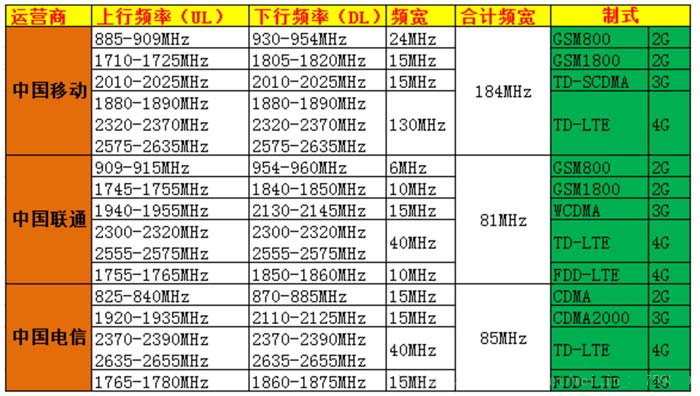
Looking at the spectrum distribution of the three major carriers, both China Mobile and China Unicom hold two bands for 2G. But in urban areas, 2G calling is already rarely used, and 3G is essentially irrelevant. Releasing part of that spectrum therefore has little real impact on most users.
The reports that have circulated so far specifically mention China Mobile shutting down all 3G service in Fujian province and plans to close all 3G base stations nationwide by 2020. By contrast, the information around China Unicom and China Telecom has been far less precise: both are said to be reducing their 2G and 3G base stations in an orderly way, but without clear figures or a fixed timetable.
Among the three carriers, China Mobile being the first to retire its 3G network was almost inevitable. In the 3G era, its TD-SCDMA network was the weakest of the three major standards in China. It was slower, offered the poorest user experience, and never became a real strength for the operator. Cutting it loose now is a rational decision.
But why was China Mobile tied to TD-SCDMA in the first place? That story matters, because the 3G period imposed a very high cost on China Mobile, and in the 4G era it was effectively allowed to move first by about a year as compensation.
TD-SCDMA originated from work at Siemens. At the time, the technology was considered too complicated and lost out in European standard-setting competition to WCDMA, which was backed by Ericsson and Nokia. After losing momentum in Europe, Siemens turned to China. With the recommendation of Li Wanlin, who had participated in 3G research at Siemens Research, the company decided to cooperate with Chinese partners and let China propose a new 3G standard.
At that moment, the smart antenna and related technologies developed by the China Academy of Telecommunications Technology, or CATT, happened to solve some of the problems Siemens had not been able to handle. The two sides then worked together, and CATT was said to hold 7.5% of the TD-CDMA-related patents at the time. As one of the proposal’s key participants, CATT was later restructured into Datang Group, which naturally became the main domestic force behind TD-SCDMA.
Even so, TD-SCDMA was never warmly embraced at the outset. The industry response was cool, and the standard did not gain broad support on its own merits. It was only with strong backing from the Ministry of Information Industry and major operators including China Mobile and China Unicom that the ITU ultimately recognized TD-SCDMA, alongside Europe-led WCDMA and US-led CDMA2000, as one of the world’s three official 3G standards.
That was a symbolic breakthrough for China. Having a homegrown proposal accepted as an international 3G standard was a major source of pride. But calling TD-SCDMA purely a Chinese standard was always somewhat debatable, since Datang Telecom was reportedly responsible for only a bit more than 10% of the patents.
Once TD-SCDMA became an official standard, the Ministry of Information Industry wanted to push it domestically. The problem was that none of the three major operators wanted it. At the time, WCDMA was more mature and more attractive commercially. In the end, the task was assigned to China Mobile.
China Mobile became the world’s only operator to deploy TD-SCDMA on a large commercial scale. Outside China Mobile, the technology was tested in a few African countries, but never achieved broad commercial use.
China Mobile is said to have invested more than 100 billion yuan in TD-SCDMA network construction. Despite that enormous spending, network performance remained unsatisfactory. Over time, the company reduced investment and stopped meaningful upgrades, which left it far behind China Telecom and China Unicom during the 3G era.
After stepping back from TD-SCDMA, China Mobile shifted its focus directly to 4G. In what was widely seen as a form of compensation, regulators issued TD-LTE licenses about a year before FDD-LTE licenses. Among the three carriers, only China Mobile used TD-LTE.
Once China Mobile moved aggressively into 4G, support for TD-SCDMA all but stalled. For Datang, which had bet heavily on that path, the outcome was grim.
Datang’s telecom business had three main pillars: Datang Microelectronics, Leadcore Technology, and Datang NXP. Yet none of them ultimately became strong enough to carry the company on its own. Leadcore and Datang Microelectronics both missed major opportunities, while Datang NXP remained slow to deliver.
Datang Microelectronics is a high-tech company focused on integrated circuit design, with roots in the former telecom research system under the Ministry of Posts and Telecommunications. It emerged from the telecom sector and, as early as the 1990s, developed China’s first public telephone IC card with independent intellectual property rights.
As mobile communications expanded, Datang Microelectronics went on to produce China’s first mobile SIM card. In order to support the domestic communications industry, break foreign technological dependence, and build a complete supply chain, the company worked across nearly every step of the process: IC card design, chip packaging, testing, card manufacturing, issuance, and even terminal, card-writing, and card-distribution systems.
But beyond these achievements, its wider chip business never gained much traction. Products such as fingerprint sensor chips and fingerprint security processing chips did not achieve major market success. Compared with the rise of firms like Goodix, Datang Microelectronics came to look increasingly marginalized.
Leadcore’s story is even more regrettable. It was founded in Shanghai in 2008, just before the smartphone boom truly took off. Positioned as Datang Telecom Group’s flagship company in mobile communications and integrated circuits, Leadcore was created in part to support the TD-SCDMA ecosystem. Yet in the 4G era it made little visible progress and gradually faded from the mainstream domestic chip landscape.
Datang NXP, a joint venture between Datang and NXP, set its sights on becoming a leader in battery management system chips. Given the rapid rise of new energy vehicles in recent years, that should have been a major opportunity. Yet since its registration in 2014, there has been little public sign of meaningful product progress.
Datang inherited CATT’s legacy, and for CATT the promotion of TD-SCDMA had long been a central mission. With TD-SCDMA now heading into retirement, that historical task can be considered complete.
That may lift a burden from Datang, but it does not solve its deeper problem. The company still failed to establish a meaningful presence in chips. Even after another merger with FiberHome, there is a real possibility that the result will be less than the sum of its parts. Leadcore and Datang NXP were both valuable assets in theory, but both missed the right window.
Datang once had its moments, first in the era of Xiaolingtong and later in the TD-SCDMA era. But those chapters are over. If the company wants a future beyond its legacy, it will need a new mission to replace the old one.