Lao He has recently been learning C++, and the process has been surprisingly enjoyable. After picking up some of the basics, he found that he could already handle a few simple problems, which made the whole thing feel quite rewarding.
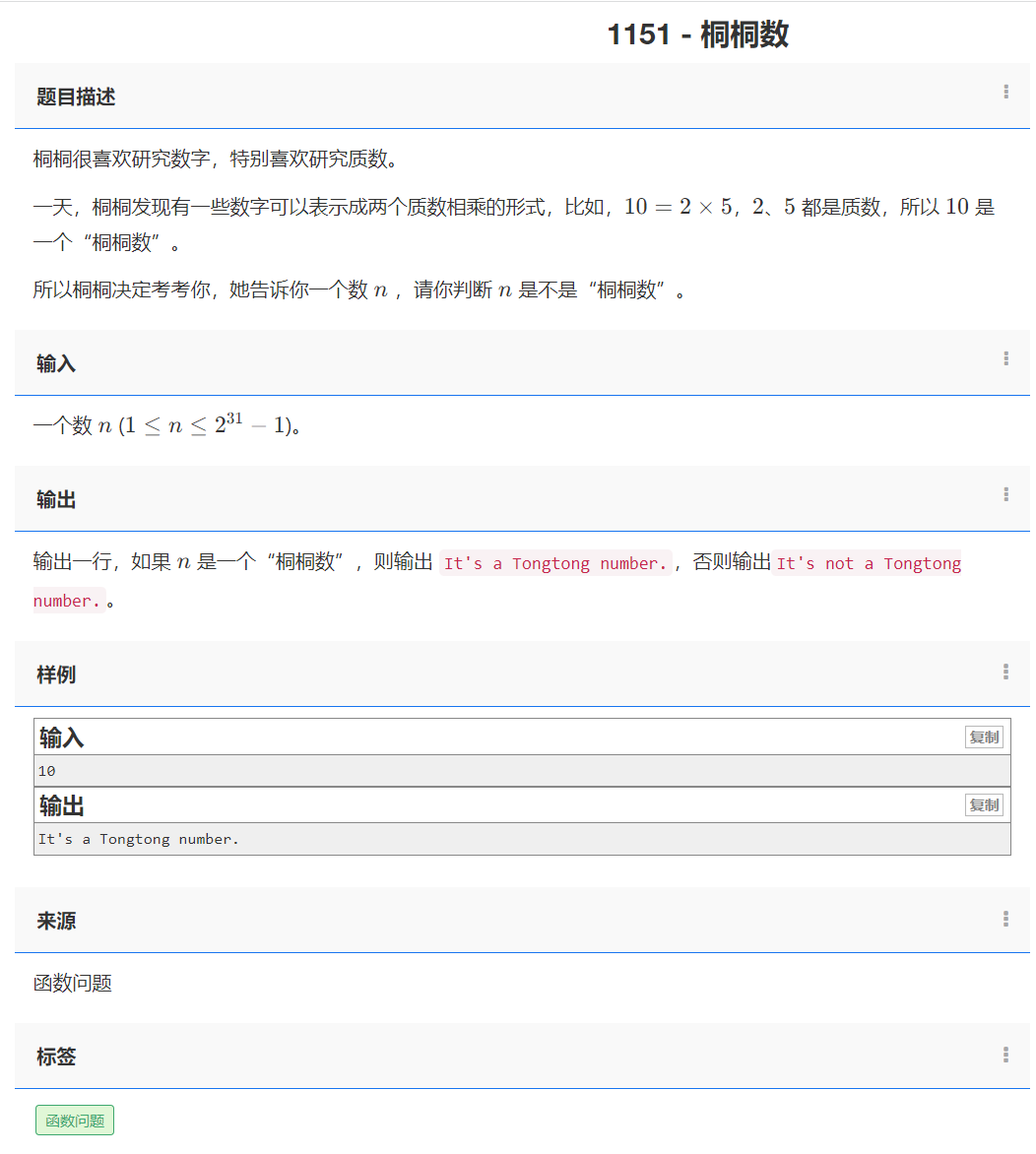
For this problem, the task can be approached in a very direct way.
Basic idea
The logic is built around factorization and prime checking:
- Break the given number into its factors.
- Check one by one whether those factors are prime numbers.
- Based on the result, output the corresponding message.
Key points involved
Several basic C++ ideas are used together here:
- If a number is not prime, then it must have at least one factor no greater than its square root.
- Defining functions and calling one function from inside another.
- Using the
booltype to represent true/false conditions. - Combining multiple small pieces of knowledge to solve a complete problem.
How the code works
The program defines two functions.
isPrime(long long x)checks whether a number is prime.yinshu(long long n)loops through the factors ofnand tests whether every relevant factor pair consists of prime numbers.
In the prime-checking function, once a divisor is found, the result can immediately be marked as false and the loop can stop. There is no need to keep checking after that.
In the factor-traversal function, the loop only needs to go up to the square root of n, written here in the form i * i <= n. If i divides n, then the code checks both i and n / i. If both are prime, it continues; otherwise, it determines that the number does not meet the requirement.
Code
<pre class="io-enlighter-pre">```
#include <iostream>
#include <cmath>
using namespace std; //定义函数判断是否质数,如果是返回true

int isPrime(long long x) {
    long long i; bool isPrime = true; //平方根的第一种表示方法
    for (int i = 2; i <= sqrt(x); i++) {
    if (x % i == 0) {
    isPrime = false;
    break; // 一旦找到一个因子,就可以确定不是质数 }
    }
return isPrime;
} //定义函数遍历每一个因数,如果全是是质数返回true

int yinshu(long long n) {
    long long i; //假设因子是质数,如果假设因子是非因数也可。
    bool prime = true; //平方根的第二种表示方法
    for(i = 2; i * i <= n; i++) {
        if(n % i == 0) {
            if (isPrime(i) and isPrime(n / i)) {
            continue;
            } else {
            prime = false; break;
            }
        }
    }
    return prime;
}

int main() {
    long long n;
    cin >> n;
    if(yinshu(n)) {
    cout << It's a Tongtong number. << endl;
    } else {
    cout << It's not a Tongtong number. << endl; }
    return 0;
    }
This is a fairly typical beginner-friendly exercise: the idea is not complicated, but it brings together factorization, primality testing, loops, function calls, and boolean logic in one small program. For someone just getting into C++, it is exactly the kind of problem that helps turn scattered syntax into something practical.