“Forget the code even exists, and focus on solving the problem.” — Andrej Karpathy
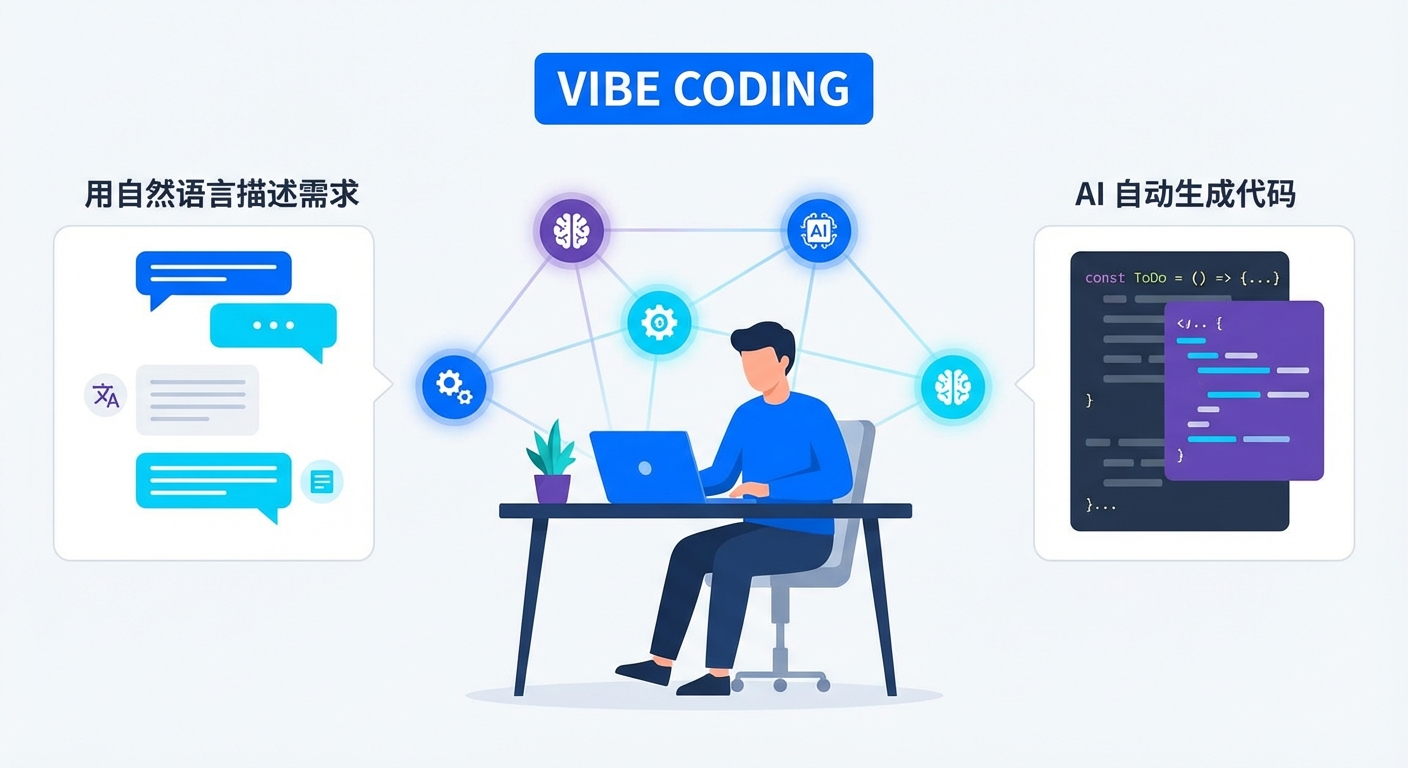
In early 2025, Andrej Karpathy gave a name to a shift many developers were already beginning to feel: Vibe Coding. The phrase captured a style of building software in which the developer describes intent in natural language, lets AI generate and revise code, and stays focused on outcomes rather than syntax.
By the end of 2025, that original idea had become something broader and more structured. What started as a loose, intuitive way of shipping prototypes increasingly turned into a more disciplined model often described as Context Coding—an AI-assisted development approach built not just on prompts, but on rich project context, explicit rules, and standardized tooling.
What Vibe Coding actually meant
In its original form, Vibe Coding was not simply “using AI while coding.” It referred to a much more radical workflow:
- requirements described in natural language instead of hand-writing everything
- AI treated as a collaborator, not just an autocomplete tool
- rapid back-and-forth iteration to test ideas quickly
- an “Accept All” mindset, where developers often take AI-generated changes without carefully reviewing every diff
Karpathy’s framing was intentionally extreme:
- “forget the code even exists”
- write little to no code manually
- rely heavily on AI even for debugging
- use it mainly for quick prototypes, personal experiments, and one-off tasks
That made the concept memorable—but also easy to oversimplify. As the term spread, people began using “Vibe Coding” to describe almost any form of AI-assisted programming. The result was a blurry label that lost precision.
From vibe to context
That ambiguity is why Context Coding emerged in 2025 as a more useful term. The idea, associated with guangzhengli, reframed the conversation around what actually makes AI programming effective: not just prompting well, but giving models the right context to work with.
At its core, Context Coding means strengthening AI’s coding ability by supplying rich, structured context from the development environment.
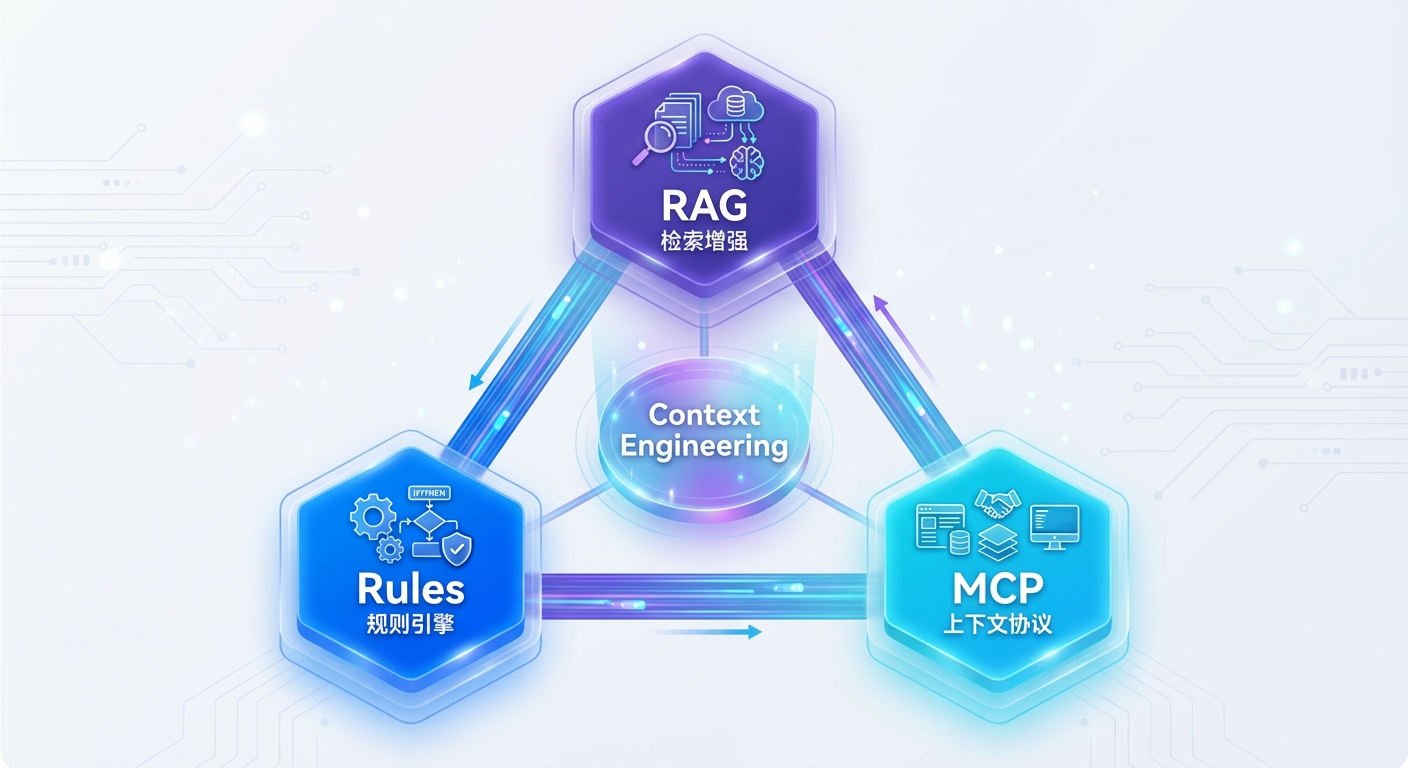
Its three main pillars are:
- RAG: retrieval of relevant project information from the codebase
- Rules: explicit constraints, conventions, and engineering standards for the AI to follow
- MCP: a standardized protocol for communication between AI systems and development tools
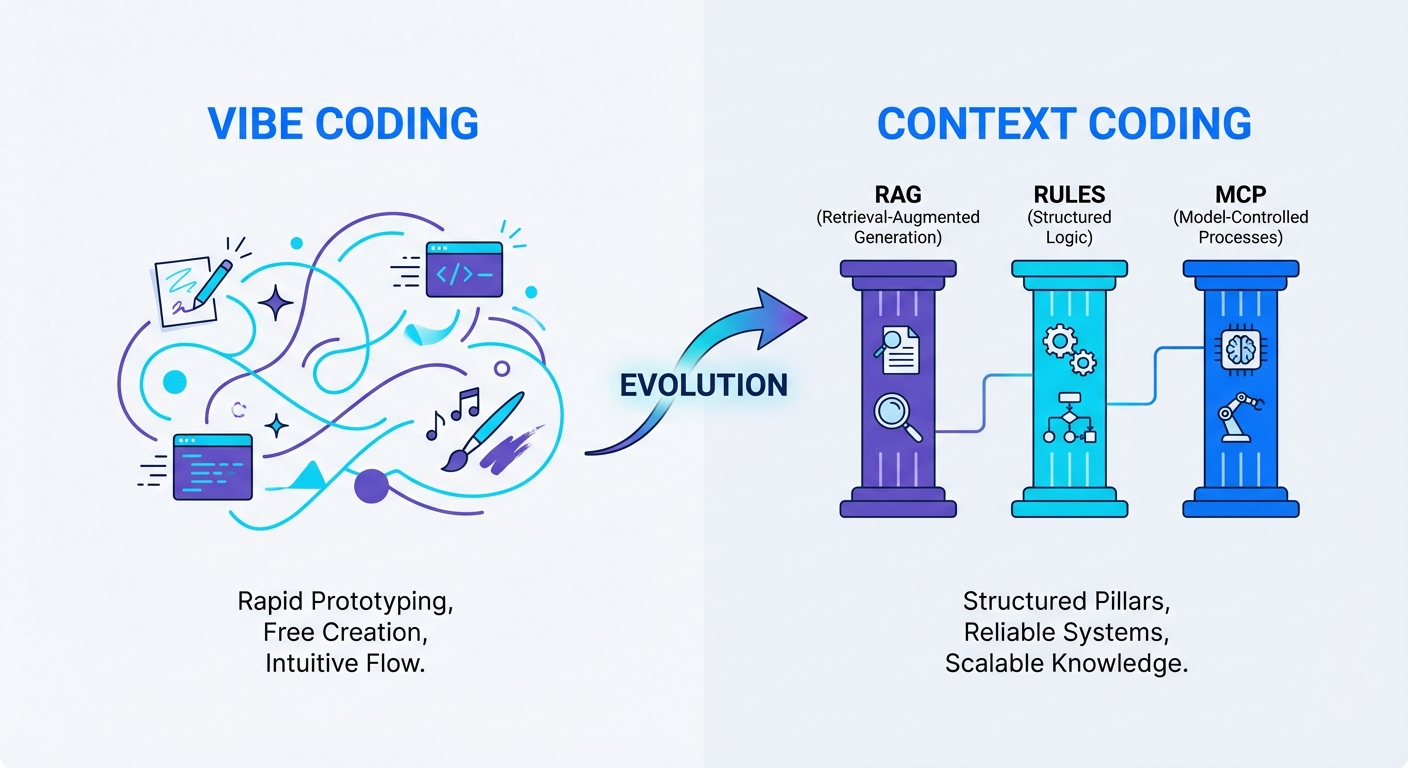
This was the real conceptual shift in 2025. Vibe Coding named the instinct. Context Coding turned that instinct into a usable methodology.
The numbers behind the shift
Several 2025 figures help explain why this change mattered:
<table> <thead> <tr> <th>Metric</th> <th>Figure</th> <th>Source</th> </tr> </thead> <tbody> <tr> <td>Developer adoption</td> <td>92% use AI tools regularly</td> <td>GitHub Survey 2025</td> </tr> <tr> <td>Productivity gain</td> <td>3.2× on average</td> <td>McKinsey Tech Report</td> </tr> <tr> <td>2026 market size</td> <td>Projected at $18 billion</td> <td>Gartner Prediction</td> </tr> <tr> <td>AI-generated code share at FAANG</td> <td>80%</td> <td>Industry Analysis 2025</td> </tr> <tr> <td>MCP servers</td> <td>500+</td> <td>MCP Registry 2025 Q4</td> </tr> </tbody> </table>The signal is hard to miss: AI programming moved from experiment to infrastructure in a single year.
How the tooling evolved in 2025
The ecosystem did not arrive all at once. It developed in distinct stages.
<table> <thead> <tr> <th>Stage</th> <th>Period</th> <th>Representative tools</th> <th>Main characteristic</th> </tr> </thead> <tbody> <tr> <td>Code completion</td> <td>2021–2023</td> <td>GitHub Copilot</td> <td>Single-file completion</td> </tr> <tr> <td>Project understanding</td> <td>2023–2024</td> <td>Cursor, Amazon CodeWhisperer</td> <td>Project-level RAG</td> </tr> <tr> <td>Context engineering</td> <td>2024–2025 Q1</td> <td>Claude Code, Windsurf</td> <td>RAG + Rules</td> </tr> <tr> <td>MCP ecosystem boom</td> <td>2025 Q2–Q4</td> <td>MCP server ecosystem</td> <td>Standardized context protocol</td> </tr> </tbody> </table>By late 2025, the major tools had differentiated themselves in clearer ways:
<table> <thead> <tr> <th>Tool</th> <th>Type</th> <th>Core strength</th> <th>MCP support</th> <th>Best fit</th> </tr> </thead> <tbody> <tr> <td>GitHub Copilot</td> <td>AI assistant</td> <td>Full ecosystem, enterprise support</td> <td>✅ Native</td> <td>Daily development, team collaboration</td> </tr> <tr> <td>Cursor</td> <td>AI-native IDE</td> <td>Multi-file editing, project understanding</td> <td>✅ Native</td> <td>Complex projects, professional development</td> </tr> <tr> <td>Windsurf</td> <td>AI-native IDE</td> <td>Cascade AI flow, privacy protection</td> <td>✅ Native</td> <td>Team projects, privacy-sensitive work</td> </tr> <tr> <td>Claude Code</td> <td>CLI tool</td> <td>Deep code understanding, terminal integration</td> <td>✅ Native</td> <td>Command-line workflows, automation</td> </tr> <tr> <td>Zed AI</td> <td>Emerging IDE</td> <td>High performance, collaborative editing</td> <td>✅ Via plugin</td> <td>Performance-sensitive projects</td> </tr> <tr> <td>Replit AI</td> <td>Cloud IDE</td> <td>One-click deployment, real-time collaboration</td> <td>✅ Native</td> <td>Education, rapid prototyping</td> </tr> </tbody> </table>The bigger story here is not which tool “won.” It is that the entire category moved from isolated assistants toward context-aware systems plugged into real development environments.
The three pillars of context engineering
1. RAG: retrieval-augmented development
RAG gives the model access to the project information it actually needs:
- source files, documentation, and historical code
- vector databases and semantic search
- project structure and team style patterns
Without retrieval, AI often writes plausible but disconnected code. With retrieval, it can reason against the codebase it is supposed to modify.
2. Rules: making standards explicit
Rules turn team conventions into machine-readable constraints:
- coding standards
- architecture patterns
- best practices
.ai-rulesconfiguration files
The point is not just cleaner output. Rules reduce style drift and make AI-generated code more compatible with how a team already works.
3. MCP: the protocol layer
Model Context Protocol (MCP), introduced by Anthropic in late 2024, became one of the most important pieces of AI programming infrastructure in 2025.
Its role is to standardize how AI systems communicate with external tools and services.
Key properties include:
- standardized communication through a unified interface
- bidirectional data flow, allowing AI both to read context and perform actions
- plugin-style architecture for modular extensions
- an open ecosystem, with 500+ servers spanning many development tasks
The MCP timeline in 2025 shows how quickly it went from idea to default layer:
<table> <thead> <tr> <th>Time</th> <th>Event</th> <th>Impact</th> </tr> </thead> <tbody> <tr> <td>2024 Q4</td> <td>MCP protocol open-sourced</td> <td>Established the basis for standardization</td> </tr> <tr> <td>2025 Q2</td> <td>Official GitHub support</td> <td>Enabled MCP integration with GitHub Actions</td> </tr> <tr> <td>2025 Q3</td> <td>Native support in Cursor</td> <td>Made MCP a standard IDE feature</td> </tr> <tr> <td>2025 Q4</td> <td>Enterprise MCP servers launched</td> <td>AWS, Azure, and GCP joined in</td> </tr> <tr> <td>2025 Q4</td> <td>NPM packages passed 1000+</td> <td>Ecosystem growth accelerated</td> </tr> </tbody> </table>A few widely used MCP servers illustrate the breadth of the ecosystem:
- @modelcontextprotocol/server-filesystem: file system operations
- @modelcontextprotocol/server-github: GitHub API integration
- @modelcontextprotocol/server-sqlite: database operations
- @modelcontextprotocol/server-brave-search: web search
- exa-mcp: intelligent search API
- rube-mcp: AI workflow automation
A practical VIBE workflow
A common AI programming loop can be described with four steps:
- Verbalize: describe the need in natural language
- Instruct: add structured instructions and constraints
- Build: let the AI generate the implementation
- Evaluate: test and assess the result
Example:
<table> <thead> <tr> <th>1 2 3 4</th>
<th>描述:创建一个任务管理应用 指令:使用 React + TypeScript,包含认证和 CRUD 构建:AI 生成完整代码 评估:运行测试,检查代码质量</th>
</tr>
</thead>
<tbody>
<tr>
<td></td>
<td></td>
</tr>
</tbody>
</table>
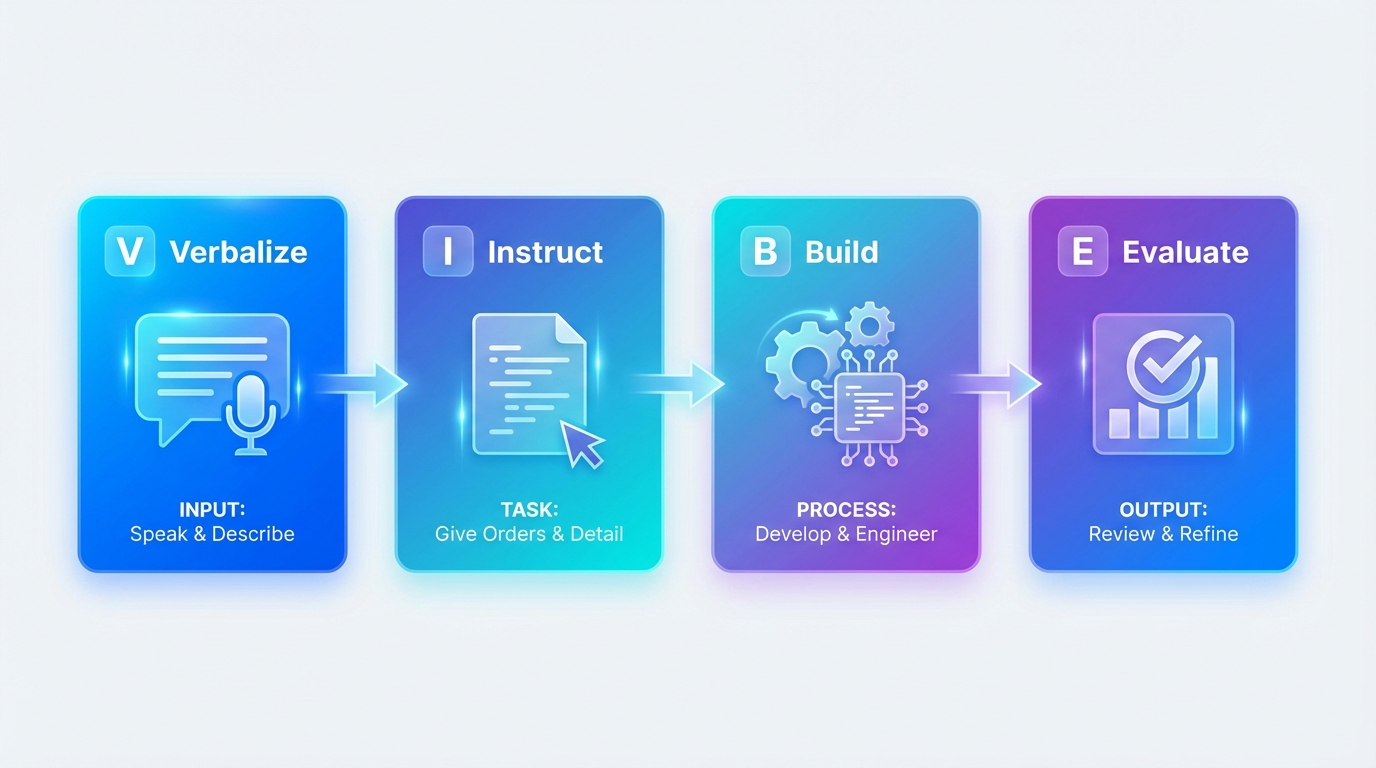
This workflow is simple, but it captures an important truth: the value is no longer in typing every line yourself. It is in framing the task well, constraining the system appropriately, and judging the output rigorously.
Three programming modes now coexist
Rather than replacing traditional software development, AI created a broader spectrum of working modes.
Traditional programming
Best suited for:
- performance-critical modules
- security-critical components
- algorithm-heavy features
Characteristics:
- full manual control
- highest code quality ceiling
- slower development speed
Vibe programming
Best suited for:
- rapid prototypes
- personal projects and experiments
- one-off tasks
Characteristics:
- extremely fast
- creatively unconstrained
- poor fit for long-term maintenance
Context programming
Best suited for:
- enterprise application development
- team collaboration
- modernization efforts
Characteristics:
- balances speed and quality
- works better across teams
- supported by enterprise-grade tooling
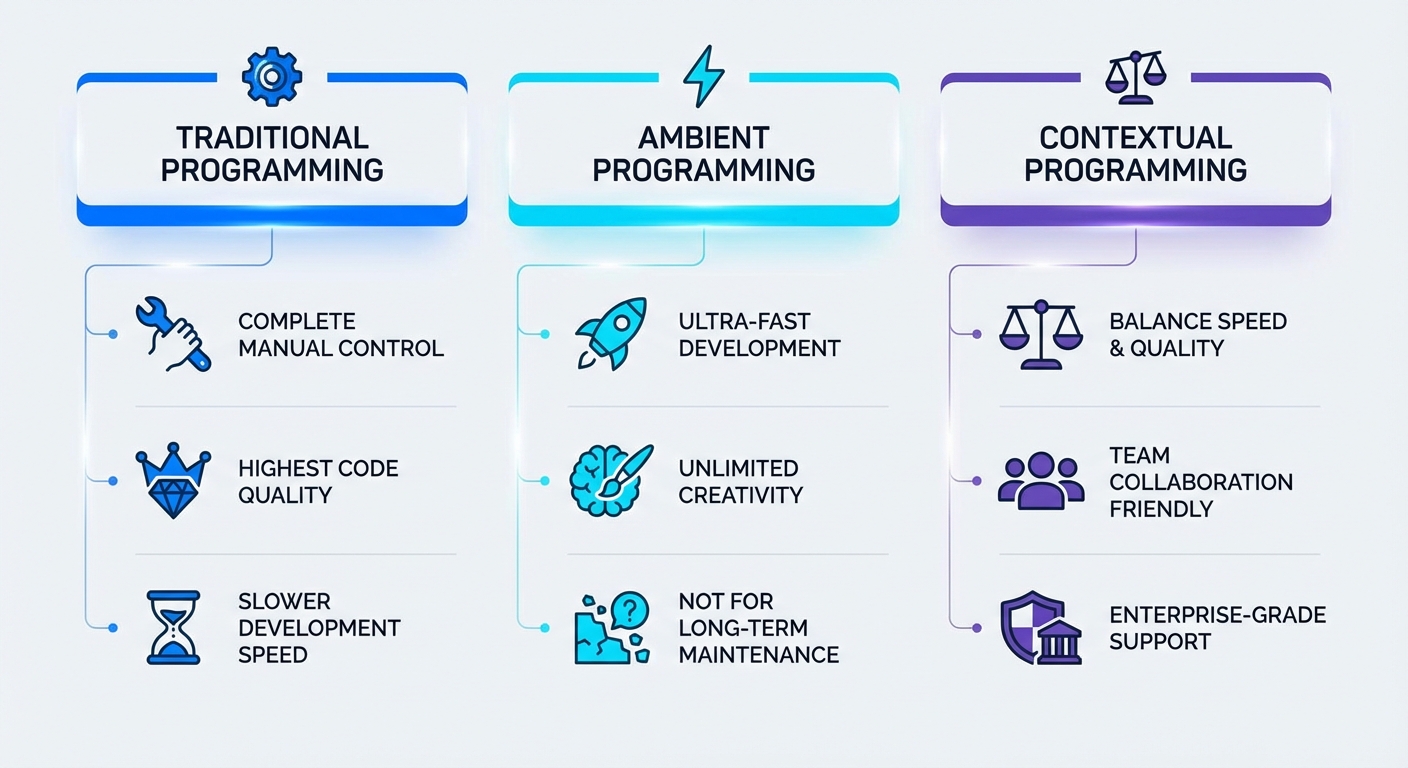
This middle category—Context Programming—is what made AI development sustainable beyond solo experimentation.
Why teams adopted it, and why they hesitated
The appeal was obvious.
Main advantages
- higher efficiency: prototype cycles that once took days could often be compressed into hours
- greater creative range: alternative implementations could be explored quickly
- better user experience for developers: lower barriers to entry and less frustration during early-stage building
But the problems were just as real.
Main challenges
- code quality risks: 50% of AI-generated code was reported to contain security issues
- team coordination problems: inconsistent coding style and weak knowledge sharing
- process pressure: faster generation made review discipline more important, not less
Typical responses included:
- stricter code review processes
- static analysis tools
- stronger testing and security checks
Choosing tools by project scale
Different project sizes called for different AI stacks.
<table> <thead> <tr> <th>Project size</th> <th>Recommended setup</th> </tr> </thead> <tbody> <tr> <td>Small projects</td> <td>GitHub Copilot + VS Code</td> </tr> <tr> <td>Medium projects</td> <td>Cursor + GitHub Copilot</td> </tr> <tr> <td>Large projects</td> <td>Windsurf + Claude Code</td> </tr> <tr> <td>Enterprise projects</td> <td>Custom AI toolchain</td> </tr> </tbody> </table>The pattern is clear: as projects grow, raw generation matters less than orchestration, context management, and governance.
Quality standards matter more in the AI era
AI can speed up implementation, but it does not remove the need for engineering discipline. If anything, it raises the bar for verification.
Suggested quality baselines included:
- performance: page load time under 2 seconds, API response under 100 ms
- security: protections aligned with the OWASP Top 10 and thorough input validation
- maintainability: code coverage above 80% and complexity below 10
Common automation layers:
- static analysis: ESLint, Prettier, SonarQube
- testing: Jest + Cypress, with 80% coverage targets
- security scanning: Snyk + OWASP ZAP
The underlying lesson is straightforward: AI-generated code should not be trusted less thoughtfully than human-written code just because it arrived faster.
A learning path for developers entering this world
Phase 1: foundations (1–2 months)
- learn the basics of one programming language, such as Python or JavaScript
- get comfortable with a basic AI coding tool like GitHub Copilot
- complete simple projects such as a personal blog or a todo app
Phase 2: capability building (2–4 months)
- study frameworks more deeply, especially React or Node.js
- learn advanced features in tools such as Claude Code or Cursor
- build a full-stack project, for example an e-commerce app or a real-time chat system
This path reflects an important shift: developers still need programming fundamentals, but now they also need to know how to work with AI productively and critically.
What changed in 2025, and what 2026 is likely to bring
Several predictions for 2025 had already materialized:
- ✅ multimodal AI integration: seamless movement across image, voice, and text in systems such as Claude 3.5 Sonnet and GPT-4o
- ✅ more intelligent assistance: AI learning from project history and offering proactive suggestions
- ✅ enterprise integration: AI coding tools becoming deeply embedded in engineering workflows
The next wave expected for 2026 points beyond assistance toward orchestration.
Emerging trends for 2026
- 🚀 Agentic AI: autonomous agents handling longer, more complex task chains
- 🚀 real-time collaborative programming: multiple humans and AI working together live
- 🚀 self-improving systems: AI continuously optimizing the codebase
- 🚀 fusion with low-code and no-code: Vibe Coding blending with visual development tools
The developer role is changing with it
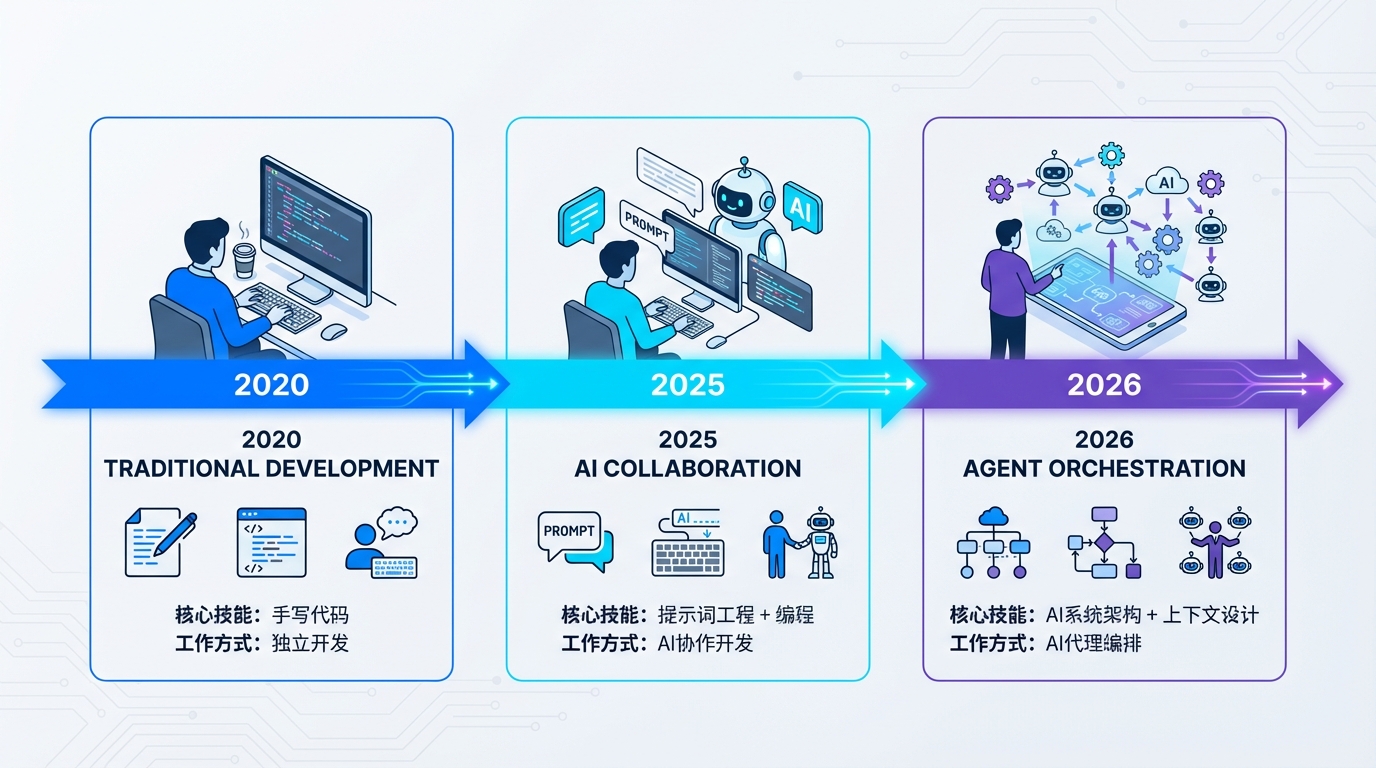
<table> <thead> <tr> <th>Dimension</th> <th>2020 traditional development</th> <th>2025 AI collaboration</th> <th>2026 agent orchestration</th> </tr> </thead> <tbody> <tr> <td>Core skill</td> <td>Hand-written code</td> <td>Prompting + programming</td> <td>AI systems architecture + context design</td> </tr> <tr> <td>Work style</td> <td>Solo development</td> <td>AI-assisted collaboration</td> <td>Orchestrating AI agents</td> </tr> <tr> <td>Value creation</td> <td>Implementation</td> <td>Rapid idea validation</td> <td>Solving complex problems</td> </tr> </tbody> </table>The expected core skills for 2026 reflect that evolution:
- systems architecture: designing maintainable AI-collaborative systems
- context engineering: building high-quality project context for models
- AI agent orchestration: coordinating multiple agents across tasks
- quality awareness: establishing review and testing systems for AI-produced code
- continuous learning: keeping pace with rapidly changing tools
From catchy concept to practical reality
By the end of 2025, both Vibe Coding and Context Coding had moved well beyond hype.
A few milestones define that transition:
- the concept matured from an informal AI-first style into a systematic methodology
- context engineering and MCP became foundational patterns
- the ecosystem expanded to 500+ MCP servers, with native support across major IDEs
- enterprise adoption accelerated, with 92% of developers using AI tools regularly
- productivity gains averaged 3.2×
- code review, testing, and AI quality assurance workflows became much more mature
The 2026 outlook follows naturally from that foundation:
- Agentic AI will take on more autonomous work
- standardization will deepen, likely through stronger protocol capabilities such as MCP 2.0
- enterprise customization will grow as more companies build their own MCP servers
- education will adapt as AI programming becomes a standard part of computer science training
For developers, the practical advice is less about chasing hype and more about adjusting your center of gravity:
- embrace the shift—AI coding is leverage, not a threat
- learn MCP deeply—context protocols are becoming a real competitive advantage
- keep technical depth—AI is a tool, not a substitute for understanding
- build strong quality habits—AI-generated code needs strict review
- keep practicing until you find a workflow that fits your work
- pay attention to the ecosystem—it is still changing week by week
The programmer of the near future is not just someone who writes code. It is someone who directs AI, designs context, and guards quality.
And the real divide in 2026 is unlikely to be between humans and AI. It will be between developers who know how to work with AI well, and developers who do not.