RSS has been around for a long time. It first appeared in 1997, which means it has nearly two decades of history behind it. I didn’t run into it until 2011, when I heard about it from a freshman who was younger than me and clearly ahead of the curve. Back then Google Reader was still alive, and my phone was a Nokia N73, so all my collecting and reading happened on a computer.
When I first got into RSS, I was obsessed with gathering feeds. It felt as if subscribing meant I would definitely read them, and that somehow made me feel productive and well-informed. After a while, though, it became obvious that this was no different from buying books and stacking them on a shelf: owning them creates the comforting illusion that the knowledge has already been absorbed. That little human self-deception works in every setting.
There was another problem too. Let unread articles pile up long enough, and they start generating anxiety. It’s not a pleasant kind of pressure. So over time I began trimming my subscriptions, keeping only the ones I truly needed. I did the same thing later with the people I followed on Weibo as well. The point was simple: reduce information noise on purpose.
A passage from Dark Time explains this particularly well:
Once we subscribe to an RSS feed, we become reluctant to unsubscribe from it. We tell ourselves that one day something important might come from it. This comes from a very human tendency: we don’t want to “close a door,” even when the chance of gain behind that door is very small.
Look carefully at the feeds in your reader and ask which ones actually provide real value. Unsubscribe from anything that offers little value, no value, or simply isn’t worth disturbing you every day. Don’t be sentimental about it. If a feed hasn’t produced anything that genuinely caught your eye in a week, chances are it never will. And even if it might, don’t worry too much about missing something precious. Truly valuable information will reach you through other channels anyway.
That one sentence stayed with me: “Truly valuable information will reach you through other channels anyway.” Once I accepted that, cutting feeds became much easier.
Then devices changed. I got a Sony, later an iPhone, while Google Reader disappeared. The account services I used after that kept changing as well, partly because of the peculiar internet environment I live in and partly because RSS readers are generally hard to monetize. Eventually I settled on Inoreader together with Reeder, the app everyone seemed to recommend by word of mouth, and I used that combination for almost a year.
Compared with official readers, Reeder really did have plenty going for it: a friendlier interface, prettier typography, support for multiple accounts, flexible swipe gestures, and a high degree of customization. Since RSS articles tend to be long and meant for deeper reading, those advantages matter. Its weakness, unfortunately, was image caching. In a place where mobile data is expensive, that becomes hard to ignore.
Last night, while searching for tutorials on Drafts 4, I followed a trail through a blogger’s Weibo account to a personal blog and found a recommendation for Unread as an RSS reader. I installed it just to try it out. After a ridiculous amount of internal debate, I ended up abandoning Reeder.
The reasons were almost exactly the ones that had been described there: image caching and layout.
With the right settings, Unread can display article titles together with summaries and images in a waterfall-style layout. That makes browsing much more intuitive and helps a lot when deciding what deserves a full, focused read. Its typography also feels a step above Reeder’s. Heading levels are clearly distinguished from body text, and the line spacing makes long reading sessions much more comfortable.
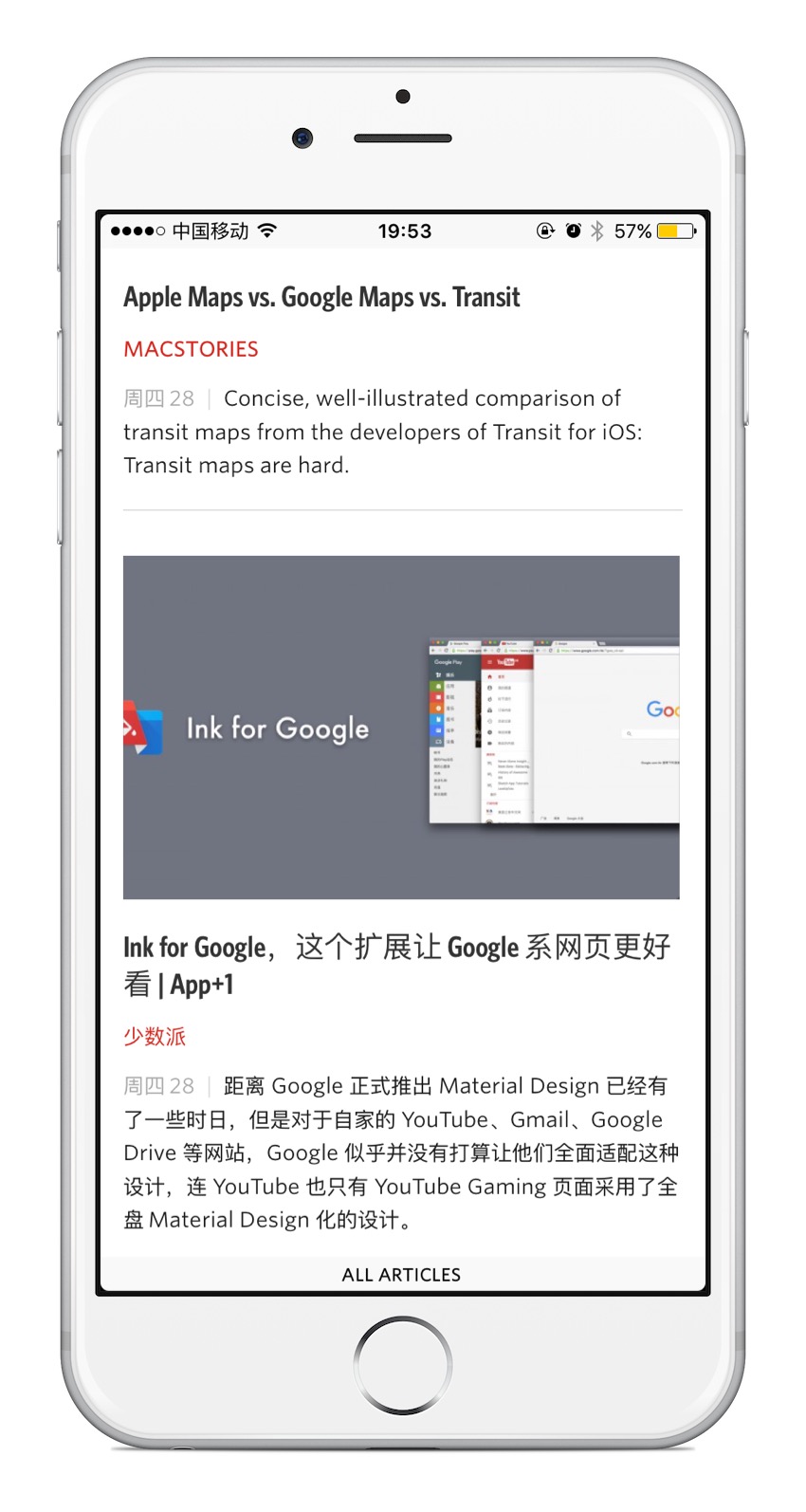
Unread isn’t perfect, of course. Its controls are not as friendly as Reeder’s. It can’t unsubscribe from feeds directly. It also supports fewer account services, and Inoreader isn’t one of them. But around that time Inoreader seemed to have become inaccessible for me anyway, so that drawback didn’t matter much. I registered a new Feedly account with a Hotmail address, imported my Google Reader XML file, and then spent an entire afternoon sorting, deleting, and reorganizing subscriptions.
Once that was done, I could finally sit back and read in peace. The satisfaction was enormous. It felt like finishing a project.
One side note: Feedly is much faster now than it was three years ago, and its official interface has become much more pleasant to use.
Afterward I started wondering why switching from one app to another had kept me tangled up for hours. Thinking about it, there were probably a few reasons:
- Sunk cost: I had already spent a lot of time comparing tools, and I had already paid money. Throwing that away felt wasteful.
- Migration cost: I was used to the interface and the gestures. The new option wasn’t overwhelmingly better; it was just a bit better.
- Self-negation: Changing tools meant admitting that my carefully considered earlier choice might not have been the right one.
- Fear of repeating the cycle: What if I switched again, then found something even better later, and had to go through the whole process one more time?
Eventually I let that go. Choosing tools is always a process; there’s no way to get it perfectly right in one shot. The trial and error involved in picking software does make later decisions more mature, maybe even steadier—like marriage, if you want to stretch the analogy a little. In the end, though, they’re just tools. Switching them usually doesn’t cost that much. Other kinds of wrong choices are harder to undo. While writing this, I couldn’t help thinking of a few failed stock trades I made recently.
As for the feeds I keep, these are the ones that made the cut:
Information technology
- 少数派
- Mac玩法
- 爱范儿
- 佐仔志
- 褪墨
- 教育资讯
General reading and knowledge
- 知乎日报
- 果壳网
- 科学松鼠会
- FT中文网
- 左岸读书
- The Big Picture
Design and visual inspiration
- 500px
- 摄影入门
- 维基百科每日图片
- Beautiful Photo!
- Flickr Blog
Commentary and opinion
- 政见 CNPolitics.Org
- 言論
- 少年中国评论
- 井底望天
- Global Voices 简体中文
My rules for keeping or dropping a feed are very simple:
- If it isn’t necessary, drop it.
- If it updates too frequently, drop it.
- If it’s too serious, drop it.
- If it hasn’t updated in too long, drop it.
- If it doesn’t provide full-text output, drop it.
- If its content overlaps too much with others, drop it.
- If it’s better consumed on another platform like Weibo or WeChat, drop it.
Really, all of that comes down to one standard: if I rarely open it over a period of time, it shouldn’t stay subscribed.