February 16, Lunar New Year’s Eve
Southbound to Foshan, with one unnecessary detour
The trip began on the morning of February 16 with train G419 from Zhengzhou East to Guangzhou South, followed by a transfer to the intercity C7610 to Foshan West.
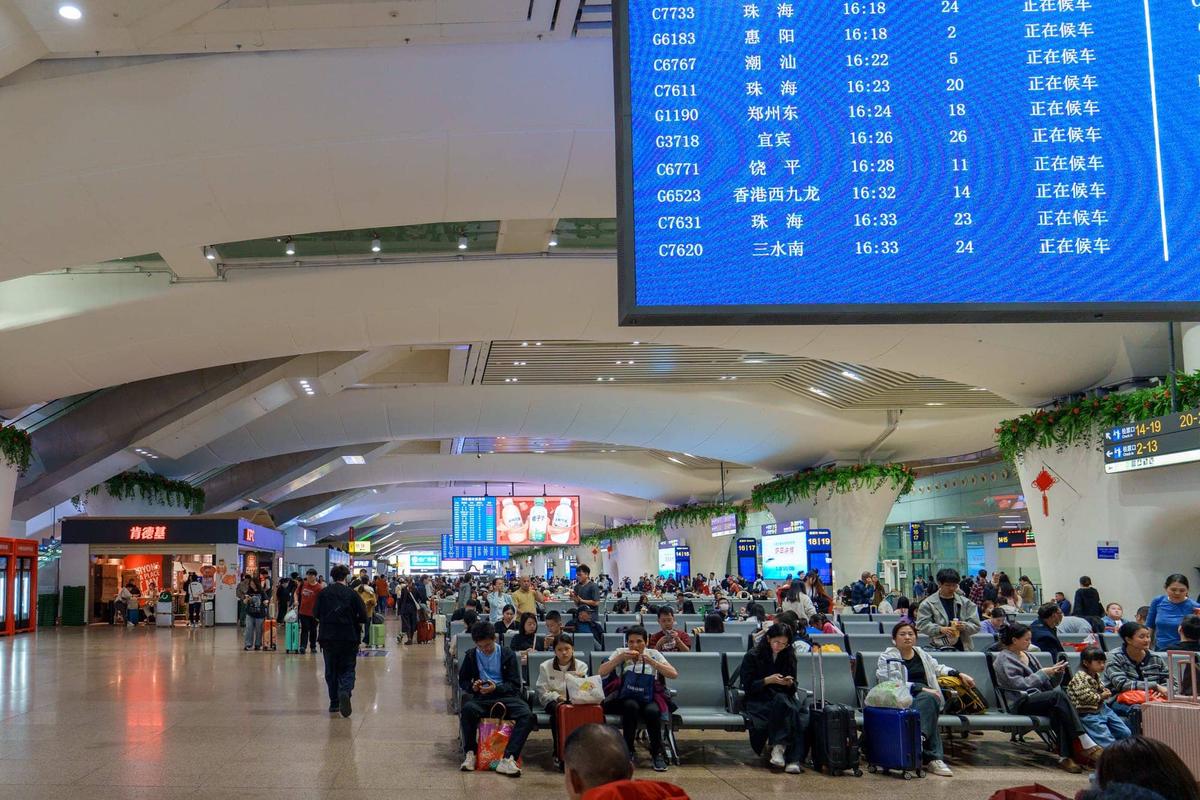
The hotel was near Zumiao Diejiao Metro Station. Only later did it become clear that there had been no need to go through Foshan West at all: the metro from Guangzhou South would have taken us directly there. That extra transfer added distance, cost us rest, and became the first lesson of the trip.
Hunting for dinner in a half-closed city
After checking in and taking a short break, we headed out around 4 p.m. toward the area near Chuihong Park, hoping to find a local restaurant. New Year’s Eve had other plans. Most places were already closed, and the map apps hadn’t caught up.
So we grabbed two shared bikes and kept riding until we reached Lingnan Tiandi, where it seemed like all the remaining tourists in Foshan had gathered. The restaurants inside were packed: long lines everywhere, and some had already stopped issuing queue numbers altogether. In the end, our first meal in Foshan came from a place on the edge of the district, Nanji Congee House.
The last evening of the flower market
After dinner, getting a taxi was still impossible, so we kept going by bike to the Zumiao Spring Festival Flower Market on Songfeng Road, which happened to be on its final day.
In Guangdong there is a saying: you haven’t really celebrated the New Year until you’ve walked through the flower market. These seasonal markets are one of the most important Lunar New Year traditions in Lingnan. People buy kumquat trees for good fortune, peach blossoms for prosperity, and all kinds of holiday goods and small trinkets much like a traditional market back home.
Most flower markets in Foshan close on New Year’s Eve, so by the time we arrived, many vendors were already packing up. Those still open were clearing out their remaining stock. We also passed the well-known local restaurant Youji. We had started queueing online while still at the hotel, but by then we still hadn’t gotten in, so we gave up.
New Year’s Eve indoors, fireworks outside the window
After the flower market, taxis were still nowhere to be found. We raced back to the hotel by bike in about 12 minutes and made it just in time for the Spring Festival Gala. That made us two more viewers contributing to Guangdong’s TV ratings for the night. Halfway through, we switched to an adaptation drama for an episode, got sleepy, and turned the TV off.
Our room sat at the northwest corner of the building, with floor-to-ceiling windows on two sides and a good view over the city. Scattered fireworks appeared across Foshan during the evening, and right at midnight we happened to catch and photograph a medium-sized burst from the window.
[](images/flash.mp4)
February 17, First Day of the New Year
Having learned from the previous evening’s restaurant disaster, we ate breakfast at the hotel. The spread was generous and included plenty of local specialties.
Kuai Zi Road and the red-paper calligraphy crowd
Around noon we took a taxi straight to Kuai Zi Road. On the way, the driver casually mentioned that locals considered the street to have a somewhat eerie reputation and didn’t usually come here. In recent years, the city has turned it into a concentrated spot for hui chun—handwritten New Year calligraphy—to draw visitors during the holiday.
The name Kuai Zi sounds like “quickly have a noble child” in Cantonese. In earlier years the street was known for wedding goods, a festive association that fit the name. But as the city changed, the old arcade buildings fell into disrepair and emptied out, which is where that ghostly local description came from. During the Spring Festival now, folk calligraphy enthusiasts and older artisans gather here voluntarily, spreading red paper on the street and writing spring couplets on the spot.
What made the place memorable was the contrast: rows of mostly uninhabited old qilou buildings, and in front of them a constant stream of tourists and photographers.
A sideways look at Renshou Temple
The schedule was tight, and Renshou Temple was still under renovation, so we didn’t go inside. But after seeing an interesting composition online, we wandered deep into a residential area and managed to catch a glimpse of the temple’s upturned eaves from an unexpected angle.
Lingnan Tiandi in full holiday mode
We had only brushed past Lingnan Tiandi the day before while searching for food. This time we went back properly and found it at peak crowd level. The decorative lanterns installed around the district were beautifully done; it was easy to imagine they would look even better after dark.
The crowds, however, were intense enough to make even a bathroom stop difficult, so we ducked into the nearby nova mall—and unexpectedly ran into a lively lion dance performance.
In Guangdong, lion dances in shopping malls on the first day of the New Year are standard holiday programming. This is known as the auspicious lion visiting the door. The lions perform the cai qing ritual, often “eating” lettuce hung high above because lettuce sounds like “generating wealth,” then spitting out bits of it to symbolically spread prosperity and good fortune to the business and the crowd.
We had considered visiting Zumiao afterward, but one look at the huge line outside made us back down immediately. It was only a little after 2 p.m. when we remembered a dessert shop across the street from where we had been dropped off earlier, so we biked over and tried it instead.
Liang Garden
After eating, we walked to Songfeng Road and visited Liang Garden.
Liang Garden is one of the landmark examples of Lingnan garden design, grouped with Yuyin Shanfang, Qinghui Garden, and Keyuan as the Four Great Gardens of Lingnan. It was gradually built during the Jiaqing and Daoguang reigns of the Qing dynasty (1796–1850) by four members of the Liang family—Liang Airu, Liang Jiuhua, Liang Jiuzhang, and Liang Jiutu—and reached its peak scale by the Xianfeng period.
Nanfeng Ancient Kiln
By the time we finished at Liang Garden it was already after 4 p.m., and hailing a taxi was still difficult. We biked to Zumiao Metro Station, took the metro to Shiwan, and got off right by Nanfeng Ancient Kiln. We did only a brief circuit there before heading back to the hotel.
Also known as a dragon kiln, Nanfeng Ancient Kiln dates back to the Zhengde era of the Ming dynasty (1506–1521) and has remained in use for more than 500 years. Because the kiln faces south and catches cooling breezes in summer, it came to be known as Nanfeng, or “south wind.” It is recognized as the best-preserved traditional wood-fired dragon kiln in the world and the one with the longest continuous use, which earned it a Guinness distinction.
Going back out alone for the night scenes
That evening my wife stayed at the hotel to rest, and I returned alone to Lingnan Tiandi to photograph the lanterns after dark. It was worth the second trip: the decorations were more striking at night, and the district had a very different rhythm once the lights came on.
After that I kept riding to Xianxing Bookstore on Chuihong Road, another spot people often recommend. It was close to closing time, so I didn’t go in; I only photographed its exterior at night. It looked like the kind of place that would also be photogenic by day, but there wasn’t time to come back.
Back at the hotel, I also tried the late-night snacks there. We had ordered takeaway as well, and both turned out to be better than expected.
February 18, Second Day of the New Year
Lining up early for the Foshan lion dance at Zumiao
After seeing the queue outside Zumiao the day before, we adjusted strategy and decided to make the earliest lion dance performance our top priority on the second day of the New Year.
We left the hotel at 7:25 a.m. and arrived at the east gate of Zumiao at 7:32, waiting for the 8:30 opening and the first lion dance show at 9:00.
The east gate had fewer people than the west gate, but it also opened later. So even though we were at the front of our line, visitors who entered from the west still beat us to the best seats once the gates opened.
There is an old saying that all lion dances under heaven trace back to Foshan. As the birthplace of the Southern Lion, Foshan’s style is deeply linked to martial arts. The lions must express joy, anger, sorrow, and delight, and then leap, twist, and land on high plum-blossom poles, making the whole performance both elegant and nerve-racking.
The wait was worth it. There was martial arts warm-up, drumming, and a particularly adorable child drummer, followed by the lions themselves. After the performance, visitors touched the lion’s head for luck.
Walking through Zumiao itself
After the show, we spent time inside Foshan Zumiao.
Also called the Beidi Temple or Lingying Shrine, Zumiao is dedicated to Zhenwu, the Dark Heavenly Emperor of Daoism. It was first built in the Yuanfeng era of the Northern Song (1078–1085), reflecting the Beidi worship brought south by migrants from the Central Plains into Lingnan. It was rebuilt in 1372, in the fifth year of the Hongwu reign of the Ming dynasty, and by the early Qing had developed into a complete, tightly structured temple complex with strong local character.
Its Sanmen, or front gate building, dates to the early Jingtai period of the Ming dynasty (1450) and serves as the architectural face of the complex. It spans nine bays with a width of 31.7 meters. Along the roofline runs a handmade ceramic ridge decoration more than 30 meters long and over 1 meter high, populated with figures. Under the eaves are gilded wood carvings that are easy to linger over.
The roof ridges are decorated with Shiwan ceramic sculpture, while the surrounding walls are covered with extensive brick carving and grey plaster carving.
The Bell Tower and Drum Tower, positioned east and west in front of the Sanmen, were built in 1629, the second year of the Chongzhen reign. Each stands on a 2.6-meter-high blue-brick platform. Beyond their ritual role of sounding the hours, they also contributed to the dignity and symbolic power of the temple precinct.
The Lingying Paifang, or Lingying Memorial Archway, was built in 1451, when the temple received the honorific title Lingying Shrine. The front bears the two gold characters Lingying, while the north side reads Shengyu. It is a precise and tightly organized structure with three tiers and three roofs, making extensive use of dougong brackets between the eaves and columns.
Cantonese opera at Wanfutai
By chance, we also caught the 10:30 Cantonese opera performance at Wanfutai.
Originally called Huafeng Stage, Wanfutai was built in 1658, the fifteenth year of the Shunzhi reign of the Qing dynasty, and is the oldest well-preserved traditional opera stage in South China. It stands on a 2.07-meter-high platform, measures 12.73 meters wide across three bays and 11.78 meters deep, with a height of 6.25 meters from the stage floor to the front eaves. Inside, gilded carved wooden panels divide the front and back stage, depicting stories from opera. Side doors marked for actor entrances and exits complete the theatrical layout.
During the Guangxu period, between 1875 and 1908, it was renamed Wanfutai to celebrate the birthday of Empress Dowager Cixi. From the late Ming and early Qing onward, Cantonese opera troupes had to premiere here before touring elsewhere, a practice known as having the stage examined. During the Republican period, the stage often hosted ritual performances offered to the gods. It was closed during the Cultural Revolution and later reopened along with the restoration of Zumiao.
From Foshan to Guangzhou, then onto the Pearl River
At 12:00 noon we returned to the hotel, packed up, took a taxi to Qiandeng Lake Metro Station, and then rode the Guangfo Line to a hotel near Nanzhou Station in Guangzhou.
We had booked a Pearl River night cruise the day before. Because Spring Festival bookings were so competitive, we couldn’t get the ideal time slot or seats, so we ended up choosing the Pearl River Crystal departing from Dashatou Pier from 19:45 to 20:45.
I hadn’t brought a tripod on this trip, and with the boat moving there was no real chance of doing long exposures. I compensated by pushing the ISO much higher than I would have liked, which hurt image quality, but there was no alternative.
Even so, seeing the night skyline from the river was still satisfying: Guangzhou Tower, the East Tower, the West Tower, and the illuminated riverbanks all lined up in different combinations as the boat moved along.
Beijing Road and the glowing Big Buddha Temple
After getting off the boat we headed to Beijing Road Pedestrian Street, which was absolutely packed.
This stretch is the core section of Guangzhou’s 2,200-year-old central axis, a commercial center that has never shifted location through the city’s history. Under the street are 11 layers of ancient road remains, dating from the Tang dynasty to the Republican period, displayed beneath protective glass. Historic sites such as the Nanyue Kingdom palace ruins and Dafo Temple are distributed along the route.
We were really there for Dafo Temple, mainly because many people had recommended it at night. Once lit up, it becomes dazzlingly golden, with a slightly dreamlike atmosphere that can remind people of the bathhouse from Spirited Away.
The temple was first founded during the Southern Han period (917–971) under the name Xincang Temple. In the Yuan dynasty the halls were rebuilt on the old site and renamed Futian Hermitage; the Ming later expanded it significantly and renamed it Longcang Temple, establishing its place among Guangzhou’s Five Great Buddhist Monastic Forests. Historical upheavals eventually reduced the complex to a single surviving Mahavira Hall, with the other halls converted into residences. Since 1996, after Venerable Yaozhi was appointed abbot, the temple has been rebuilt and gradually revived.
February 19, Third Day of the New Year
A solo march across Guangzhou’s skyline viewpoints
I got up early and spent the morning on a self-imposed mission: visiting a series of spots for views of Guangzhou’s so-called three-piece skyline—Guangzhou Tower, East Tower, and West Tower.
- 8:00 — Took the metro to Datang Station, exited at D, and walked to Shengtang Business Center for a now time-limited composition featuring the three landmarks and a site reportedly facing demolition.
- 8:32 — Biked to Haizhu Tongchuanghui and photographed the skyline with the well-known “Guangzhou” wall, helped by the near-empty holiday atmosphere there.
- 9:03 — Reached Haizhu Lake Park, only to discover that bikes were not allowed inside. To get the view of the flower fields across the lake with the skyline behind them, I ended up walking 2.4 kilometers round-trip.
- 10:02 — Made it to Jinxiu Yinwan Residential Community and climbed to the rooftop for the so-called road into the city view. Without a telephoto lens, I had to rely on heavy cropping later.
- 10:28 — Arrived near Dashi Metro Station, but gave up on another location for the same reason: still no long lens, and by then I had already walked more than 9,000 steps before heading back to the hotel in a half-ruined state.
Nanting Village, because a comic made it meaningful
Later we went to Nanting Village in Panyu because it was the real-world inspiration for the comic Guwei Nanting. My wife is a fan, and the village sits beside the Guangzhou Academy of Fine Arts, which is also the school connected to the comic’s creator.
So this became a small pilgrimage stop of its own. We also visited the nearby Guan Clan Ancestral Hall and looked around the academy.
Crossing the river on Haixin Bridge
After 2 p.m. we took a taxi to Haixin Bridge and crossed the Pearl River on foot. The weather was good, which made it a pleasant place to photograph Guangzhou Tower and the surrounding buildings from different angles. From there we biked to Hongcheng Park for another widely photographed viewpoint.
Yongqing Fang, then a retreat from the crowds
Yongqing Fang is often cited as one of the best examples of gentle renewal in Guangzhou’s old urban core. It preserves a large amount of old Xiguan arcade architecture. Walking over the stone-paved lanes, you pass trendy shops, studios connected to intangible cultural heritage, and even the former ancestral home associated with Bruce Lee.
It was enjoyable, but the Spring Festival crowds were too much. We didn’t stay long before biking out of the congestion and retreating toward Huangsha Metro Station.
Since my wife liked the morning photos from Haizhu Tongchuanghui, and the place had felt much quieter than the main tourist areas, we went back so she could take some portraits there too. With the afternoon sky clearing, the second visit produced even better results.
Guangzhou Opera House and a brief APM ride
Toward evening we took a taxi to the Guangzhou Opera House for another recommended angle pairing the building with Guangzhou Tower.
After that we rode one stop on the APM line, getting on at Huacheng Avenue Station and off at Women and Children’s Medical Center Station. Using a cheap portable phone tripod my wife had bought for only a few dozen yuan, we managed some long-exposure night shots.
The Guangzhou APM line is a fully underground automated people mover running through the core of Zhujiang New Town, and for anyone sightseeing in the CBD it is a remarkably convenient little route.
February 20, Fourth Day of the New Year
Sun Yat-sen University, decided on at the last minute
By the final day, nearly every well-known place in Guangzhou was still overcrowded, and we hadn’t really settled on a plan.
At 10:20 a.m. we decided on Sun Yat-sen University’s South Campus. Online reservation slots were already full, but after checking we learned that on-site booking was possible, and indeed we got in smoothly by scanning the code at the entrance.
Inside, the old trees and campus buildings made for a calm break from the holiday crowds. After leaving, however, we ran into the now-familiar problem of the trip: restaurants on and around campus were largely closed. Eventually we found a place near Hopson Plaza for lunch.
Dongshankou, quieter than the headline attractions
After lunch we took a taxi to Dongshankou, which felt noticeably less crowded than many of the city’s better-known destinations.
Dongshankou is one of Guangzhou’s first designated historic and cultural conservation districts, bringing together layers of revolutionary history, overseas Chinese culture, and urban memory. The area retains more than 400 small Western-style houses built during the Republican period. One notable address, 12 Xuguyuan Road, known as Baiyuan, was once the founding site of the Institute of History and Philology of the National Central Research Academy. In recent years, urban renewal has introduced art spaces, designer shops, and cafés while still preserving ordinary neighborhood life, including places like the traditional Dongshan wet market. That coexistence gives the district its particular character.
Sacred Heart Cathedral, seen only from outside
Afterward we took another taxi, this time with a distinctly ill-tempered driver from the northeast, and got off in a hurry near Sacred Heart Cathedral.
Unfortunately, the cathedral was closed for the holiday, so all we could do was photograph it through the iron fence.
Also known as Shishi, the Sacred Heart Cathedral of Guangzhou was completed in 1888, the fourteenth year of the Guangxu reign. Its soaring form, deep interior space, intricate detailing, pointed arches, stained-glass windows, and tall towers make it one of the most distinctive church buildings in the region. It is the only well-preserved granite Gothic cathedral in Southeast Asia and one of the four all-stone Gothic churches in the world.
Sand Island abandoned, then northbound home
Close to 4 p.m., we took the metro to Cultural Park Station intending to go to Shamian Island. But within moments of exiting the station, one look at the pedestrian bridge and the crowd density made us abandon the idea on the spot and turn straight back to the hotel.
At 5:00 p.m. we picked up our luggage and headed for Guangzhou South Station. At 17:40 we boarded G420 and began the journey north, arriving safely at Zhengzhou East at 22:58.
Along the way, the train passed through a spectacular sunset, and I managed to catch the moment on my phone.
[](images/IMG_4535.mp4)
What we ate along the way
There was no shortage of good food in Foshan and Guangzhou, but the Spring Festival timing meant a lot of restaurants were closed, so the range we could try was narrower than it should have been.
A few places stood out:
- Nanji Congee House: the first proper meal in Foshan, with dishes like Hong Kong-style fried beef chow fun and scrambled egg with yellow chives.
- Jiuji Bafang Desserts (takeout): mango pomelo sago and grass jelly with taro balls.
- Lidong Dessert Shop: mango double-skin milk, red bean paste with dried tangerine peel, local-style rice noodles, and an ice-hot pineapple bun.
- Luming Cantonese Dim Sum (takeout): ordered while we were still sitting in the hotel restaurant, and frankly more satisfying than the hotel dinner itself. The order included shrimp siu mai, steamed chicken feet, congee, rice noodle rolls, sticky rice wrapped in lotus leaf, and mixed noodles.
- Tangji Shunhe Dessert Shop: taro paste double-skin milk, ginger milk curd, tossed noodles, and brown sugar glutinous rice cakes.
- Exin Xin Roast Goose: char siu and roast goose lai fun.
- Xizuo Handmade Cantonese Dim Sum: a very solid meal with shrimp dumplings, soy sauce fried noodles, char siu buns, rice rolls with beef brisket and pork intestine, and a notably good pineapple bun.
- Changping Bamboo-pressed Wonton Noodles: beef tendon brisket noodle soup, curry fish balls, shrimp wonton noodles, and soup dumplings with crab roe and chicken broth.
- Tangchu Laoyou Rice Noodles: both the lean pork and beef brisket versions were excellent.
The final surprise was that little street-side Guangxi noodle shop, which turned out to be one of the tastiest meals of the entire trip.
And yes, somewhere in the middle of all that, we also ate at McDonald’s, which has branches everywhere in Guangzhou. The burgers weren’t anything special, but after eating local food nonstop for several days, fast food somehow tasted unexpectedly comforting.